

By David Musa Pidcock
President Macron says Islam ‘in crisis’, prompting backlash from Muslims

‘Islam is a religion that is in crisis all over the world today’, says Macron, as he unveils plan to defend secularism.
French President Emmanuel Macron delivers a speech to present his strategy to fight ‘radicalisation’ on October 2, 2020 in Les Mureaux outside Paris [Ludovic Marin/AFP] 2 Oct 2020
French President Emmanuel Macron delivers a speech to present his strategy to fight ‘radicalisation’ on October 2, 2020 in Les Mureaux outside Paris [Ludovic Marin/AFP]
2 Oct 2020
President Emmanuel (GOD BE WITH US?) Macron has unveiled a plan to defend France’s secular values against what he termed as “Islamist radicalism”, saying the religion was “in crisis” all over the world, prompting a backlash from Muslim activists”.
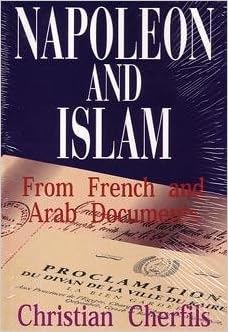
Placing him in direct opposition to the views of Napoleon Bonaparte, who, according to official French and Arab documents first published in 1914 by Christian Cherfils, in his book Bonaparte Et L’Islam, plus independent testimony from the likes of Goethe and Auguste Comte who’s reply to Macron back then would still remain: “even from an intellectual aspect, atheism only constitutes a very inadequate emancipation, since it tends to prolong indefinitely the metaphysical state in ceaselessly pursuing new solutions to theological problems instead of discarding as essentially vain all the researches pursuing the same inaccessible questions.”

The Gazzette National ou Le Moniteur Universel which announced Napoleon’s conversion to Islam on the 6th of the 12th 1798, and his adoption of the name Ali Boneaparte. Brings us to a significant bone of contention regarding the contents of this book. It is clear, from reading the original Preface by Sherif Abd el-Hakim, that he must have been commenting on selected extracts unaware of the entire contents of the book for he speaks uncritically of Napoleon’s “love” for Islam and his “blissful sojourn” amongst the Muslims.
On the other hand we have the attitude of, allegedly, ‘well informed Muslims’ who have tried to dismiss, out of hand, his conversion as a purely cosmetic exercise: “The pragmatic gamble of an astute, cynical operator who, when it suited him, professed whatever creed was necessary to achieve his political objectives.“
Speaking from personal experience, as a politically active European convert, the publication of this fact could not have helped him politically as it galvanised the disparate forces of Polytheism and high finance into an effective, zealous alliance, with unlimited financial resources at their disposal to mobilise sufficient men, materials and black propaganda to frustrate his reforms. Being notorious for often throwing out their babies with the bath water, one of the main stumbling blocks for Muslims in studying this book, and turning it into a useful weapon, stems from a injudicious declaration by Napoleon which stated that he believed that he was destined to achieve greater military victories than the Prophet Muhammad, a man he greatly admired: (See Document xxxviii).
Furthermore, or so it would appear, he believed that he (like the Mahdi AS), was destined to play a major, preordained role, in the revival of Islam. This is not unusual for zealous converts or converts wishing to appear zealous. His Russian campaign, according to McNair Wilson, was not a misjudged, reckless affair, but a situation forced upon him through a treacherous betrayal, by amongst others Talleyrand.
Muslims would do well to recall that the Sudanese Mahdi – who attracted a huge following – but could not have been the one ordained to revive Islam, because he did not fulfil the criteria set down in all the authentic hadith literature. It was not uncommon, even amongst divinely inspired prophets, peace be upon them all, for them to introduce some personal elements of desire into the messages they were entrusted to convey, a point clearly made in verse 52 of Surah 22 the Hajj or the Pilgrimage in the Qur’an: “Never did we send an apostle or a prophet before you (Muhammad), but when he framed a desire, Satan through some vanity into his desire: but Allah will cancel anything vain that Satan throws in…” Napoleon, after all, was only human.
Having said that – The Memorial of Napoleon by William Hazlitt, the British essayist and critic (1778-1830), is a fitting tribute to Bonaparte, who, whatever the case may be, must be regarded as an enlightened individual, certainly when compared with the likes of Nelson, Wellington and their paymasters at N.M.Rothschild: “He put his foot on the neck of Kings, who would have put their yokes upon the necks of the People: he scattered before him with fiery execution, millions of hired slaves, who came at the bidding of their Masters to deny the rights of others to be free.
“The monument of greatness and of Glory he erected, was raised on ground forfeited again and again to humanity – it reared its majestic front on the ruins of the shattered hopes and broken faith of the common enemies of mankind. If he could not secure the freedom, peace, and happiness of his country, he made her a terror to those who by sowing civil dissension, and exciting foreign wars, would not let her enjoy those blessings.
They who had trampled upon Liberty could not at least triumph in her shame and her despair, but themselves became objects of pity and derision. Their determination to persist in extremity of wrong, only brought on them repeated defeat, disaster, and dismay: the accumulated aggressions their infuriated pride and disappointed malice meditated against others, returned in just and aggravated punishment upon themselves: they heaped the coals of fire upon their own heads: they drank deep and long, in gall and bitterness, of the poisoned chalice they had prepared for others: the destruction with which they threatened a people daring to call itself free, hung suspended over their heads, like a precipice, ready to fall upon and crush them.
‘A while they stood abashed,’ abstracted from their evil purposes, and felt how awful Freedom is, its power how dreadful. Shrunk from the boasted pomp of royal state into their littleness as men, defeated of their revenge, baulked of their prey, their schemes stripped of their bloated pride, and with nothing left but the deformity of their malice, not daring to utter a syllable or move a finger, the lords of the earth, who had looked upon men as of an inferior species, born for their use, and devoted to be their slaves, turned an imploring eye to the People, and with coward hearts and hollow tongues invoked the Name of Liberty, thus to get the people once more within their unhallowed grip, and to stifle the name of Liberty for ever.”
“If he was ambitious, his greatness was not founded on the unconditional, avowed surrender of the rights of human nature. But, with him, the state of Man rose exalted too. If he was arbitrary and a tyrant, first, France as a country was in a state of military blockade, on garrison duty, and not to be defended by mere paper bullets of the brain; secondly, but chief, he was not nor could he become, a tyrant by ‘right divine.’ Tyranny in him was not ‘sacred’: it was not eternal: it was not instinctively bound in league of amity with other tyrannies: it was not sanctioned by all ‘the laws of religion and Morality.”
APPENDIX III
NAPOLEON’S PERSISTENCE WITH BONAPARTIST IDEA ON THE SUPERIORITY OF ISLAMIC PRINCIPLES CONVERSATION BETWEEN NAPOLEON AND GOETHE
We do not pretend to establish, from the few documents which follow, Napoléon’s pure and simple persistence in Bonapartist ideas. Every man who thinks also evolves, and we are not writing today the history of a philosopher’s thinking, but that of his progresive thinking, in brief, the evolution of his doctrine. All the more reason why the thinking of the statesman should also be subject to evolution….
What we want to establish is no more than this :
(a) Persistence of the profound effect exerted on Bonaparte by the religion of the Prophet, whom he loved;
(b) By implication, the absolute sincerity of the Cairo proclamations and the instructions he gave there;
(c) And in consequence, the compounded error levied against Bonaparte the Islamophile: shortcomings of the French leaders who did not understand him, and took it as a joke; lack of foresight within the population and among a majority of the indigenous top people, who failed to gauge the importance of the occasion.
We know the passionate interest of Goethe in everything that touches on Islamism. He had translated Voltaire’s Mahomet (1), and eliminated everything hostile to the prophet’s memory. (2)
When they met, on the 2nd October 1808, Goethe and Napoléon almost immediately started talking about Mahomet.
Here is Goethe’s account:
The Emperor takes his lunch, sitting at a very large round table; on his right, at a few steps from the table, stands Talleyrand ; on his left, and close by him, is Daru, with whom he discusses the taxes to be raised.
The Emperor signals for me to make my approach.
I remain standing before him, at a respectful distance.
Having looked me over carefully, he says, “You are a man.”
I bow my head. He puts a question:. “How old are you?”
“Sixty.”
“You are well preserved. You have written dramas?”
I give a minimal response.
Here Daru takes up the theme. In order to flatter the Germans and to a certain point soften the pain he was forced to inflict upon them, he had studied a little of their literature; Daru knew Latin literature very well, indeed he was the author of an edition of Horace.
He talks about me as the most favourable critics in Berlin might have done, at least I recognised in his words their ideas and mannerisms.
He added that I had translated French works, notably Voltaire’s Mahomet.
The Emperor replied, “That is not a good play.” And he further revealed in a very detailed fashion how little it suited the conqueror of the world to make such an unfavourable portrayal of him..
He then turned the conversation to Werther, whom he must have studied from beginning to end…..
The Emperor seemed satisfied and came back to the drama; he made significant observations like a man who had studied the dramatic scene as carefully as a criminal judge, and who had strongly felt that the mistake of the French theatre is to distance itself from Nature and truth.
While developing this aspect, he disapproved of the dramas where fate plays a major role: “These plays belong to an epoch of darkness. Besides, what do they mean by their fate? Politics is fate.” (3)
On Saint Helena, after a reading of Voltaire’s Mahomet by Marchand, Napoléon expressed his ideas on the play, and Marchand collected them. These notes are, as the editor says, “the impulse of a frank opinion”. Therein their merit lies.
_____________________________________
(1) Translator’s Note: Mahomet is the French spelling, which has been used throughout this version.
(2) About this very strange matter, see Friedrich Warnecke: Goethe’s Mahomet – Problem, Halle.
(3) See S.Sklower, conversation between Napoleon 1st and Goethe, by S.Sklower, Lille, Ernest Vanackere, 1853.
Napoleon Et’L Islam is, therefore, a major contribution to understanding someone who clearly had more than a passing interest in the Qur’an, its Message and its Messenger – peace and blessings be upon him. Whether or not he fasted or prayed five times a day is really of secondary importance (for there are many today who claim to be Muslims and do neither) what is important, however, is the fact that he truly recognised Islam as a superior system to the one prevailing elsewhere (then as now) and took a great deal of it for his own use and the benefit of his empire.
As the Holy Qu’ran states: Islam is a mercy to all creation. Furthermore he correctly concluded that the religion of Abraham would be revived through its sciences. Present day developments in Malaysia and other parts of the Islamic world seem to indicate that the Muslims are beginning to wake up to this important fact. No longer content to rehearse an endless litany of former glories – they are once again beginning to take notice of the Prophet’s (PBUH) advice particularly where he said: “Search for knowledge even unto China”. As we approach the beginning of a new century whoever emerges this time to revive the fortunes of Islam he would do well to consider Napoleon’s vision:
“I hope that the time is not far off when I shall be able to unite all the wise and educated men in the country and establish a uniform regime based on the principles of the Qur’an which alone are true and which alone can lead men to happiness… Christianity preaches only servitude and dependence…” (See Part Four – Correspondences of Napoleon Ist, No.3,148. page 110.)
On reading Napoleon & Islam, Mr Macron, like Lafitte, the Liberal Banker, on his way to the Hotel De’Ville following the July Revolution, is likely to also let slip the same remark given to the Duke of Orleans: ‘Hence forth the bankers will be in control’].
OR SO HE THINKS – BUT OTHER EVENTS ARE ABOUT TO CHANGE THE PRESENT ORDER.


 Forward March