BORIS JOHNSON’S ERROR LADENED SPEECH ON THE BALFOUR DECLARATION PART 2
By David Musa Pidcock
 Boris Johnson Secretary of State for Foreign and Commonwealth Affairs 5:18 pm, 30th October 2017.
Foreign Secretary, back in 1998, I had the great good fortune of being able to speak directly with James E. Akins, in Washington, the former American Ambassador, to Saudi Arabia, and to have received from him, in writing, verifiable facts, which clearly help us to understand the historical origins of past, present and future confrontations in the Gulf as outlined by Engdahl and Tony Benn and Michael Meacher elsewhere; it is clear from his candour and the nature of his disclosures that Ambassador Akins did not conform to the traditional definition of a diplomat i.e., that of being – “An honest man sent abroad to lie for his country”.

From Left: Henry Kissinger, King Faisal and U.S. Ambassador James E. Akins
This may have been the intention of those who sent him but, just like Tony Farrell, the former Principal Intelligence Analyst for the South Yorkshire Police Force, who was fired for refusing to falsify his 2010 TERROR THREAT ASSESSMENT in order to blame Muslims for the 2005 London Tube Bombings, he too, proved to be a man of principle and considerable courage.
As far as he was concerned, the policy currently being pursued by America and her willing, and not so willing coadjutors, is the same one devised by the author of NSSM 200, the war criminal Henry Kissinger, back in the mid 1970’s which, according to Ambassador Akins, called for the depopulation not only of Saudi Arabia, and it’s re-population with Oklahoma and Texas oilmen – but of the entire Arabian peninsula including Kuwait and the United Arab Emirates.
This will come as no surprise to those who have studied Kissinger, and his National Security Memorandum 200, which sees “population growth” as the greatest threat to American interests and calls for the depopulation of at least 13 other countries with a maximum global population reduced to some 500 million.
In the following letter, addressed to me and faxed to my home in England on the 20th of February 1998, Ambassador Akins made the following, astonishing disclosures, subsequently confirmed by his 1975 – ‘WAR FOR OIL’ REPORT, which, after a five year delay, I obtained in its entirety from the State Department in Washington, which I will append for your perusal:

Dear Mr. Pidcock,
in early 1975 some twelve articles appeared in American newspapers and magazines on ‘How we can solve our economic problems.’
The basic idea was that we would occupy the Arab oil fields from Kuwait to Dubai (not Iraq), expel the indigenous populations, “not more than 2 million, bring in Texan and Oklahoma oil men who would produce the oil. The inevitable cries of “imperialism” from the third world would be immediately stilled by our selling them oil for $2.50 a barrel. The reaction of the Soviet Union and the Arabs themselves was conveniently ignored. It was clear that the articles came from a single “deep background” briefing. I assumed it was given by some idiot in the Pentagon or the CIA and said on American television that: “anyone who proposes solving our domestic economic problems in this manner is a madman, a criminal or an agent of the Soviet Union.”
The oilfields would have been destroyed by the Arabs and, under the best of circumstances; they could not have been restored to production for two years during which the economies of Europe, Japan and the United States would have collapsed. I wrote a long report on the subject; it had low classification*** and should be available from the State Department under the Freedom of Information Act.
Congress subsequently did a study on the same subject and backed me on every point. Subsequently several of those who were present at the briefing revealed that Henry Kissinger was the one who gave it. Many assumed that I was fully aware of this when I made my statement on the subject. This was untrue; I may be daring but I am not suicidal; had I known the identity of the briefer I would still have opposed the idea but I would have been more cautious in my choice of words. Kissinger was not amused and my diplomatic career was terminated shortly thereafter.
“In 1990 in the run up to the Gulf war, I said publicly – perhaps in England as well – that Saddam, through his invasion of Kuwait, had given the US the opportunity to destroy the infrastructure of Iraq, which I considered the most important Arab country and, as a bonus, to occupy the Arab oilfields as recommended in 1975, but with no losses, indeed, with the cooperation of the Gulf Arabs.
I never suggested nor did I believe then or now that our plan was to exterminate the Iraqi people to make way for the settlement of Soviet Jews. In fact, until I read your account of Ms.(Dr. Kitty) Little‘s paper (calling for the impeachment of Tony Blair), I had no idea that anyone held such ideas. Ms. Little did not invent the story about Israeli plans to occupy all the lands ‘from the Nile to the Euphrates, including Medina in Saudi Arabia.
The Zionists at the Versailles conference (1919) presented a map of Eretz Israel; its borders would include all of Palestine, all of southern Lebanon up to Sidon, all of southern Syria, not just the Golan, including the entire Jebel Druze, and all of inhabitable Trans-Jordan.


The Israeli Agrot depicts their map for ‘Greater Israel’

The two blue lines on the ‘Israeli’ flag, represent Jewry’s demented desire to occupy all the land between the Nile and the Euphrates.
- The Israeli anthem, ‘HaTikvah’, contains the lines: ‘L’hiyot am chofshi b’artzenu. Eretz Tzion v’Yerushalayim’–‘In the land of Greater Zion and Jerusalem’.
- The Eretz Israel (‘Greater Israel’) plan was promoted by Ben-Gurion, and is mentioned in official Knesset documents…
“It must now be said that it (the Jewish state) has been established in only a portion of the Land of Israel. Even those who are dubious as to the restoration of the historical frontiers, as fixed and crystallised and given from the beginning of time, will hardly deny the anomaly of the boundaries of the new State.”
David Ben-Gurion, “Israel among the Nations”, in State of Israel, Government Year-book, 5713 (1952), page 15.
“It is called the ‘State of Israel’ because it is part of the Land of Israel and not merely a Jewish State. The creation of the new State by no means derogates from the scope of historical Eretz Israel”
State of Israel, “Israel, the State and the Nation” in Government Year-book, 5716 (1955), page 320
James E. Akins Letter to David Musa Pidcock continued…
The Herut party (now part of Likud) uses as its logo this map superimposed by an arm carrying a rifle and the word ‘Kahk” – only thus. This concept has never been disavowed by the Herut/Likud. Israeli expansionist aims were and are bad enough; there is no need to exaggerate them.
As for Iraq as a place for settlement of Soviet Jews, I believe Ms’ Little is confused. The late Rabbi Kahane said that within three months of his becoming defense minister, Israel will be ‘free” of its Arab population – by this he meant Arabs in Israel as well as those in the occupied territories. And the main area of settlement of these Arabs would be Iraq, with its adequate land, water and oil. Even Kahane never talked about Israel occupying Iraq.
I served in Iraq for 4 years and have a great affection and admiration for its people. They have the great misfortune to be governed by a monster. I have long said that within 10 years of the overthrow of Saddam a demilitarized Iraq would be known as the Japan of the Middle East. “I’m no longer sure of this; some of the best Iraqi minds are out of the country and many will never return; Iraq’s education and health systems – comparable in many ways to the best in the west – have been destroyed, children who are near starvation cannot learn much at school.
I would like to see sanctions lifted; they have failed completely in their stated goal of removing Saddam who is stronger, internally, than he was in 1990. Starving, desperate peoples do not make revolutions; their only concern is finding enough calories to survive the day. Many in the Middle East believe the US needs Saddam in power to retain its hold on the Arabs of the peninsula. While I am not privy to the workings of official American political circles I doubt if there is any such intention. Americans don‘t think in such terms, at least those currently in power (in Feb 1998) don‘t. I myself believe Saddam must go – and the sooner the better – before [the] resurrection of Iraq can begin… [ends]
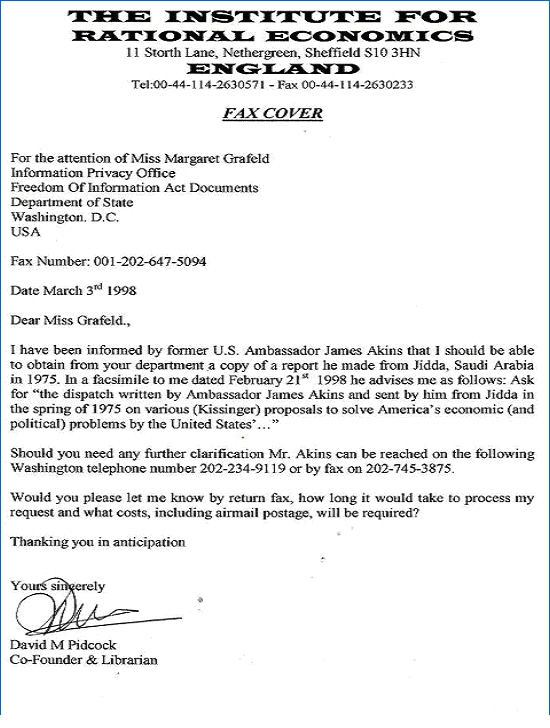
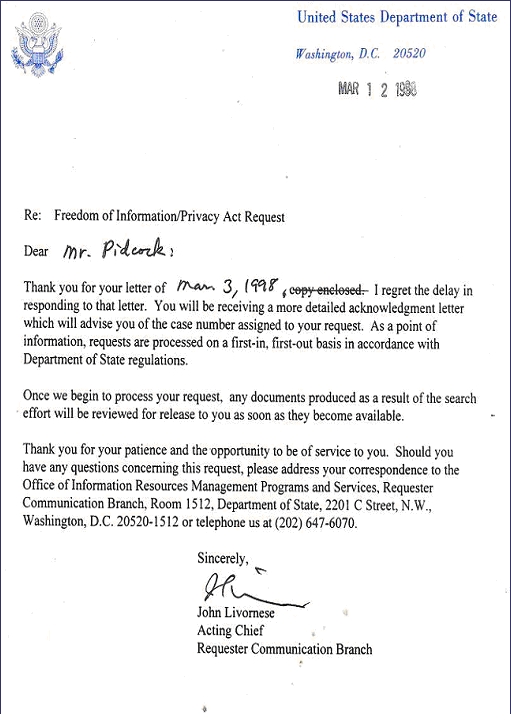
5 YEARS LATER…
Received by the U.S. Embassy in London on either JAN or JUN 29 2002.
However, for obvious reasons, the envelope with its damning contents was not posted on to me by the Embassy in London until August 2003 long after the 2nd invasion of Iraq.
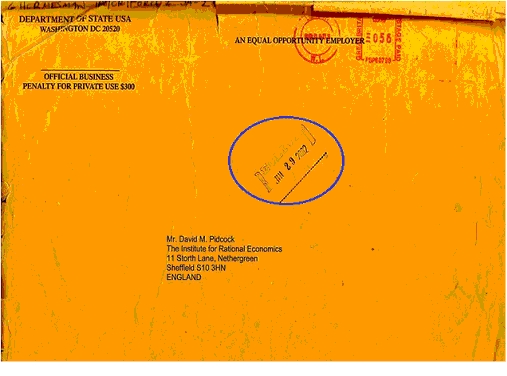
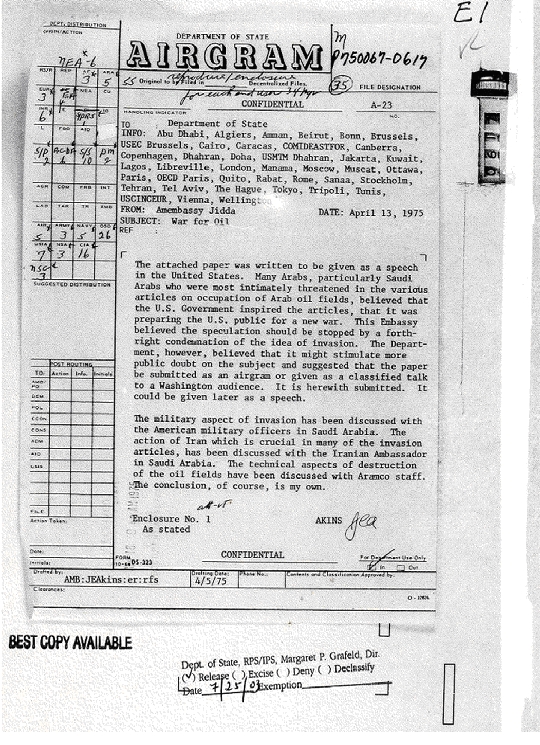
NOTE THE 2002 BLUE RINGED DATE STAMP
James E. Akins is described in the 1986-87 International edition of Who’s Who as an: “American diplomatist, writer and lecturer. Born in 1926; educated at Akron University; U.S. Navy 1945-46; undertook relief work with non-profit organisations. 1948-50; taught in Lebanon 1951-52; held numerous diplomatic posts in Paris 1954-55, Strasbourg 1955-56, Damascus 1956-57, Kuwait 1958-60, Baghdad 1961-64; Washington, D.C. 1965-67, Dir. Fuels and Energy Office 1968-72; U.S. Ambassador to Saudi Arabia 1973-75. Publications: numerous articles on oil (including the attached War For Oil) and energy policy and the Middle East.
NOTE: THIS IS AN OCR TEXT VERSION MADE FOR EASE OF ELECTRONIC TRANSMISSION AND DOWNLOADING FROM THE INTERNET. THE CONTENTS ARE IDENTICAL ONLY THE FONTS & LAYOUT DIFFER SLIGHTLY FROM ORIGINAL WHICH IS ALSO AVAILABLE.
DEPARTMENT OF STATE
A I R G R A M P750067-0617
CONFIDENTIAL
TO: Department of State
INFO:Abu Dhabi, Algiers, Amman, Beirut, Bonn, Brussels,
USEC Brussels, Cairo, Caracas, COMIDEASTFOR, Canberra,
Copenhagen, Dhahran, Doha, USMTM Dhahran, Jakarta, Kuwait,
Lagos, Libreville, London, Manama, Moscow, Muscat, Ottawa,
Paris, OECD Paris, Quito, Rabat, Rome, Sanaa, Stockholm,
Tehran, Tel Aviv, The Hague. Tokyo, Tripoli, Tunis,
USCINCEIJR, Vienna, Welling.
FROM: Amembassy Jidda DATE: April 13, 1975
SUBJECT: War for Oil
REF
The attached paper was written to be given as a speech in the United States. Many Arabs, particularly Saudi Arabs who were most intimately threatened in the various articles on occupation of Arab oilfields, believed that the U.S. Government inspired the articles, that it was preparing the U.S. public for a new war. This Embassy believed the speculation should be stopped by a forthright condemnation of the idea of invasion. The Department, however, believed that it might stimulate more public doubt on the subject and suggested that the paper be submitted as an airgram or given as a classified talk to a Washington audience. It is herewith submitted. It could be given later as a speech.
The military aspect of invasion has been discussed with the American military officers in Saudi Arabia. The action of Iran which is crucial in many of the invasion articles, has been discussed with the Iranian Ambassador in Saudi Arabia. The technical aspects of destruction of the oil fields have been discussed with Aramco staff. The conclusion, of course, is my own.
Enclosure No. 1
As stated
AKINS
CONFIDENTIAL
AMB: JEAkins:er:rfs DRAFTTNG Date 4/5/75~
BEST COPY AVAILABLE
Dept Of State, RPS/IPS, Margaret P.Grafield, Dir.
(Release ( )Excise ( )Deny ( )Declassify
[Date 7/25/003 Exemption]
Enclosure No. I
Jidda A-23
CONFIDENTIAL
INDEX
WAR FOR OIL:
ARMAGEDDON AS FUN CITY
I. Introduction 2
II. The Flaws in the Basic Premise
and the Moral Issue 6
III. The Reactions of Others to
Invasion 10
IV. The Invasion and Its Costs
V. Saudi Actions and Reactions 20
VI. The Length of the Cutoff and
the Consequences 25
VII The Alternatives to War 29
VIII Conclusion 32
James E. Akins – Jidda
March 1, 1975
Revised March 30, 1975
CONFIDENTIAL: Enclosure No. 1 Jidda A~23 Page 2 of 34
I. Introduction
Secretary of State Henry Kissinger in an interview in January said the United States would react with force if we were being strangled by a cut-off in oil deliveries. The question was hypothetical, but no one could maintain that there could have been any other response than the one he made. To have intimated that we would simply allow ourselves to be “strang1ed” would have called for his immediate impeachment. Secretary Kissinger in a subsequent interview said that he obviously had not meant there could be military action just to bring down oil prices.
The implications of the first remark nonetheless were noted with concern in most of the Organization of Petroleum Exporting tries (OPEC) and in Europe. Many of them condemned the Secretary and the United States for this “provocation.” Saudi Arabia made no public statement and no representations to us. Saudi officials told us in private discussions that they understood what the Secretary meant and they trusted us. In spite of significant differences of opinion and actions on the Middle East problem – they regarded their friendship with us as a cornerstone of their foreign policy. They knew we knew this and they knew Saudi Arabia was too important to the United States and its allies for us to jeopardize this close association.
Enclosure No I Jidda A-23 Page 3 of 34
The invasion issue would probably have been quietly forgotten had it not been picked up, embellished, and presented to the world in five separate articles, all of which were widely quoted and discussed in the United States, Europe, and the Middle East. The first was in a prominent journal of intellectual opinion – it appeared shortly after Secretary Kissinger’s statement and was reproduced in the Sunday edition of Washington’s morning newspaper.
Then there were two articles in widely-circu1ated American newspapers which were based on “sources” inside the Pentagon Then in mid-February, the Sunday edition of another major newspaper carried a detailed account of how many actions could be taken against OPEC short of war but that even war could be carried out if necessary and occupation of Arabia should be easy.
Most recently and most provocatively was the lead article in the March issue of a literary magazine. Some of the articles and the related commentary concentrated on military action against all the Arabs, some against the Arabs of the Persian Gulf but a common theme to all of them was the necessity of occupying Saudi Arabia. Some insisted this move be taken immediately as the West was already being “strangled’ by the high oil prices; all five articles agreed this would be done in time of war. And all five agreed that only Saudi Arabia had enough oil to force down world oil prices.
The premise, on which all the articles were based, was that the high price of oil is the main problem the world’s economy faces today; that inflation and unemployment are caused by the price of oil and that there is no way we could or should cooperate with the OPEC countries. This being accepted, the authors continued that we have the right to take the oil, that we could take it with a minimum of difficulty, that supplies would be disrupted for only a very short time, that Saudi Arabia and its OPEC allies would be powerless to react, and that the Soviet Union, because Saudi Arabia was a “friend” of the United States, would not intervene or allow its Middle East allies to intervene.
Invasion, it was argued, would be simple, cheap and easy. Furthermore, it would be morally justified, in fact, it is a moral imperative for us to take over Saudi Arabia, produce its oil and sell it for almost nothing. The world’s inflation would then be cured; unemployment would end; and we would devote – ourselves to the task of finding new energy sources when the Saudi oil would finally be exhausted.
Enclosure No.I Jidda A-23 Page 4 of 34
The losers would clearly be the Saudis. To some, the dispossession of six million Saudis would be regrettable, but – it would be argued – a small price to pay for world happiness. The 200 million living in other OPEC countries – Indonesia, Iran, Venezuela, Nigeria, Algeria, would of course also be hurt but they would not be invaded. Their loss of income would just be one of life’s difficulties to which they would have to adjust.
The January article was answered by I F Stone in the New York Review of Books February 5. In his essay – ‘War for Oil,” Mr. Stone condemned the immorality of the invasion proposal and details how it could lead the world and particularly the United States to disaster. The invasion proposal, as such, was attacked by Terence McCarthy in the March issue of Ramparts. His thesis was that the United States, unable to discipline itself into facing its internal economic problems, would attempt an external solution. It would try to seize the Arab oil fields, restore its own prosperity, and reduce Europe and Japan to vassalage. It would also run the very real risk of a nuclear war in which the Soviet Union, because of its still fairly primitive society, would be the relative winner.
I gave a press interview in Jidda in early March in which I characterized those who call for war as being criminally in-sane. The interview was widely quoted in Saudi Arabia and the Arab world and Prince Fahd, now the Saudi Crown Prince, said this went a long way toward defusing the issue. Secretary Kissinger in Riyadh on March 19 said again that war for economic reasons was impossible, that our policy was “cooperation not confrontation*” His statement was quoted in the Arab world, but was lost in the United States in the flurry over the deterioration of Southeast Asia.
*NOTE: (1) REMEMBER AMBASSADOR AKINS SAYING ABOVE: THAT WHILST HE MAY BE BRAVE HE WAS NOT SUICIDAL: AT THAT TIME, 1975, AMBASSADOR AKINS WAS COMPLETELY UNAWARE THAT IT WAS KISSINGER WHO HAD PROPOSED THE IDEA OF “WAR FOR OIL” AND IT WAS KISSINGER WHO HAD ALSO BRIEFED THE PRESS. (2) AS HE POINTED OUT IN HIS FAX AND E-MAIL LETTERS TO ME IN FEBRUARY 1998. IN SPITE OF IT HAVING “A LOW CLASSIFICATION” IT STILL TOOK 5 YEARS – FROM 1998 TO AUGUST 2003 IN ORDER TO GET A COPY – AS MENTIONED ABOVE FROM THE STAMP ON THE ENVELOPE IT WAS FURTHER DELAYED FOR 1 YEAR IN LONDON FROM IT’S DATE OF RECEIPT JUNE 29 2002 UNTIL THE SECOND GULF WAR WAS WELL UNDERWAY.
Enclosure No 1 Jidda A 23 Page 5 of 34
The feeling of unease in the Middle East continued. True, the polls and letters to the editors in the United States strongly condemned the invasion idea, and the articles by Stone and McCarthy were favorably quoted. Yet even those who opposed a war for oil assumed that it was a possibility. Some even publicly expressed their fears that the United States was preparing its people for a new military adventure. This fear, unfortunately, was shared by many in: the Middle East -some even in Saudi Arabia.
There was another flurry of excitement in the Middle East – In particularly in Saudi Arabia – at the time of the death of King Faisal. We were alleged to be alerting the Seventh Fleet, to be preparing our citizens for evacuation, to be spreading the story of disturbances in the Kingdom in order to justify occupation of the oil fields to prevent sabotage. No matter that there had been no disturbances.
The main reason for this continuing fear of war is almost certainly that there has been no strong, detailed condemnation of the invasion concept by a member of the American -Administration, no analysis of why it could bring only disaster to the United States and to the world, and why – it could not be considered for both moral and practical reasons. This is what I intend to do.
Enclosure No 1 Jidda A 23 Page 6 of 34
II The Flaws in the Basic Premise – and the Moral Issue
There can be no doubt that the sudden rise in oil prices by 400 percent has contributed to the world’s current economic ills. But it is conveniently forgotten that the world faced a serious inflation before the massive oil price increases of 1974; that unemployment was large and growing, that wages were growing faster than productivity;’ in short, that we were living beyond our means. Imported energy helped our economic expansion for over twenty years. ‘It enabled us to escape the consequences of increasing real wages faster than productivity increased. Oil was very cheap. Its price, even in current dollars, declined from 1950 to 1972 and its 1972 price in constant dollars was half that of the early l950’s. The oil producing states increased their incomes only by allowing production to grow faster than real prices declined.
All of the oil producers, by 1970, had come to realize that their oil reserves were finite, in some cases quite small; all could see-when their oil’ production would Start to decline and all bad begun to think of how to increase income per barrel. All that is;- except Saudi Arabia which was and is unique. It is a truism to state that oil is a wasting asset, that once used it is gone forever.
But most consumers chose to ignore-this; they compared the profit on a barrel of oil with the’ profit on a bushel of wheat and they seemed convinced that the comparison was valid. The oil producers, on their side, believed they must maximize their income, invest their money and prepare to face the post-oil age. With the shortages caused by the Arab oil boycott in late 1973, all OPEC countries saw what the world would pay for oil. The Shah of Iran announced that OPEC would no longer subsidize the industrialized West. The era of cheap oil, he said, was over forever.
Enclosure No. 1 Jidda A-23 Page 7 of 34
OPEC took advantage of its new knowledge to increase oil prices, some say to intolerable levels. It would surely have been far better if the world had agreed to a gradual increase in oil prices, the consumers before 1973 were not willing to consider such ideas. Our professional soothsayers told us oil prices were low of necessity and would go even lower.
We believed them and we did nothing to develop alternative sources of energy. But can it be pretended that the current high cost of oil is the sole source of our economic problems? Or can anyone seriously think that a forced reduction of oil prices could miraculously solve all our problems? To think so is to share the fairytale beliefs of certain academicians newly converted to the dubious pleasures of militarism. Alan Greenspan, the President’s chief economic advisor put (it) very well recently: We had inflation before the oil price increases and we would still have it if oil prices decline. Inflation, he said, is a productivity problem, not a commodity problem.
No discussion of price gouging would be complete without some reference to our own role in food exports. The same magazine which in March carried an article calling for the immediate invasion of Saudi Arabia carried in its (1975) February issue an article which, asserted that our monopoly of food exports was more complete than OPEC’s in oil and much more damaging to the underdeveloped countries. Wheat prices go up by 400 percent; rice by 300 percent; soybeans by as much and we speak only of “market forces” of supply and demand” but the effect on the consumer is as brutal as that caused by any cartel. Even if oil prices were as crucial to the world’ s economy as is pretended, and even if food prices or declining productivity were irrelevant, could we seriously propose invasion, an act of international brigandage so contrary to our national traditions and repugnant to our religious heritage?
Enclosure No. 1 Jidda A-23 Page 8 of 34
Senator James McClure Of Idaho asked in January if our Viet-Nam venture would have been justified in the eyes of the New’ Hawks if we had said we had gone to South Asia to appropriate its rice to feed the world’s poor. To say that we have the right simply to take oil or any commodity because its price is too high, as our authors have suggested, threatens the relatively stable political order the United States has hammered together since the Second World War.
After a successful seizure of the Arabian oil fields – why not foreign deposits of bauxite, lead, zinc, tin, chrome, and other resources in short supply? Even renewable resources such, as rubber, cotton and food, would seem fair game. To postulate that.- the United States and only the, United States would be allowed dispensation for such imperialistic action wou1d be naive. Yet one who purports to be a “defense consultant” concluded his article calling for invasion of Arabia by asking why we needed to spend $85 billion a year for our Armed Forces if we were not going to try to get something out of them. Presumably he had never heard of Defense or of Deterrence.
There are ample recent historical precedents for aggression of this sort, but they are not ones we should be quick to quote. Japan went to war to establish its “Greater East Asian Co-prosperity Sphere”; that .is, to secure access to land, tin, rubber, rice and oil. Hitler said had a right to Poland because the efficient Germans could use the land more effectively than the “lazy Slavs.” Hitler also found the concentration of wealth in the hands of Jewish merchants an intolerable burden to Aryan pride. While neither the Japanese nor the Nazis pretended to benefit the entire world, the parallels between their actions these new proposals are close enough to be uncomfortable.
Enclosure No. 1 Jidda A-23 Page 9 of 34
Senator McClure commented on his amazement at the call for invasion and wonders why it had not been soundly denounced in the United States, particularly by those who deplored our Viet-Nam war. Why, he asked is every newspaper in the country not besieged with letters decrying the immorality of such an idea’ He and others have commented on the curious transformation of Viet-Nam doves into Middle East hawks.
The entire idea of invasion by the United States should be laid to rest solely by the moral argument. There should be a wave of indignation, of outrage that the idea considered and even justified by respected intellectuals.
Invasion for economic reasons is something one would expect to read only in standard communist propaganda describing the moral bankruptcy of America. Unfortunately, the idea continues to be discussed; and the conclusion in some parts of the world – at least Europe and the Middle East – is that someone may be trying to soften up the American people for a new war, that American morality – at least as publicly expressed – has been blunted.
If such is the case, and I am certain it is not, then it would still be necessary for us to examine carefully how United States interests would be affected by such a war before advocacy of war be translated into policy.
Enclosure No. 1 Jidda A-23 Page 10 of 34
III. The Reactions of Others to-Invasion
The plan of the New Hawks is to occupy- the oilfields-of Saudi ‘Arabia. Some include Qatar, Bahrain and Kuwait in their targets, but clearly these states are peripheral. — Saudi Arabia, it is argued,’ would be quite sufficient by itself to satisfy our energy needs. Saudi Arabia after ‘the seizure of its oil fields, might be allowed enough income to pay for its essential imports, but the rest of the revenue from the oil sales would be distributed among the poor of the world.
This Robin Hood aspect of aggression allegedly would win us the tacit if not the overt’ support of the under developed world. And the resulting low oil prices would bring us the applause of the developed world ‘from Western Europe to Japan.
To suggest that any nation would applaud invasion because of the conscience money we would pay (from someone-else’s pocket) assumes its inability to draw some obvious conclusions. The Arabs and Iran have been generous in economic assistance far more so than the U.S. has ever been in per capita terms.
In 1974 Saudi Arabia gave to Arabs for arms and reconstruction and to other states more assistance – a total of $3 billion – than did the United States with a GNP 50 times greater. In addition, last year it loaned $2 billion to the World Bank and the International Monetary Fund. In fact, total OPEC assistance has been at least as great as whatever the Less Developed Countries (LDCs) could hope from oil sales at new rock-bottom prices. The direct total OPEC aid, according to an OECD study, has almost precisely offset the current higher oil prices to the LDCs, and the several billions given to the IBRD and the IMF have eased the burden still further on the LDCs.
Nonetheless, the aid has not been uniformly distributed and it cannot be denied that the high oil prices have hurt some countries badly. They still expect OPEC to assist them and OPEC would be well advised to implement fully the enlarged aid program it has discussed.
Enclosure No. 1 Jidda A-23 Page 11 of 34
After an invasion for oil, the questions every producer of raw materials would have to ask himself would be: (1) How’ much of this new source of petroleum wealth will I get? He might just conclude it would be insignificant; and (2) When will the United States decide my bauxite, cobalt, or copper would justify its appropriation? He could conclude it would be quite soon. In any case the support of the LCD’s for invasion would be minimal; they are too recently freed- of colonial-masters to welcome the emergence of a new colonialism, no matter how elevated it would claim its motives to be. And, as irrational and irritating as it may seem to us, most LDCs really seem to enjoy vicariously the new strength of OPEC; If OPEC does not help them soon with their financial problems they could, however ever, change, their views quite completely.
The opposition of the other Arab states seems to have been ignored in the invasion plans. Many of the many not be-particularly well disposed to Saudi Arabia or its leaders, but it is inconceivable that Syria, Jordan, Egypt, Libya, and Iraq would not do everything they could to frustrate an American invasion of another Arab country. Part of our folklore about the Arabs is that they do not always behave rationally; they sometimes cut off their noses to spite their faces. There is some truth in this. But if our plan is to destroy them, there would be little incentive for them to show any restraint whatsoever. We will come back to this later.
The reaction of other OPEC countries – Indonesia, Venezuela, Nigeria – would be hostile. While they might not be invaded, once the battle for natural resources began, there would be no guarantee of their own immunity from attack. And no OPEC country would react to an invasion of Saudi Arabia by giving away its natural resources merely to curry our favor. A more logical reaction would be for them to sell their oil for whatever they could get $25 – $30 a barrel and then to do everything in their power – to insure that the United States did not flood the world with cheap Saudi oil. To suggest, as do some of our author, that we would get full cooperation from Iran in such a military venture is also extraordinarily naive. The Shah of Iran wishes to restore his country ancient grandeur and he has a good chance of success. But to achieve this goal Iran will need to sell its oil at or near its present level. If the avowed or the implicit purpose of invasion of Saudi Arabia would be to break OPEC, to drive oil prices down to $2 or. $1 a barrel or perhaps even lower, Iran could do nothing but cooperate with the Arabs in opposing the U.S. landings.
One of the most fanciful of the invasion ideas has been the admission that Iran would try to come to Saudi Arabia’s defense and the assertion that the Iranian military forces could be paralyzed simply by allowing key American advisors to go on vacation the day before the landings. This assumes the Iranians would be both too stupid to notice what was happening and too incompetent to act without their American advisors. No one who knows the Iranians – whatever else he may think of them – has ever suggested that they are stupid. While no one pretends that the Iranian Army and Air Force are the most powerful in the world, they are at least capable of mining the Straits of Hormuz and of giving the Saudis support against the landings of American troops – all without their American advisors. The proposal to buy the Shah off by giving him Kuwait is scarcely worth considering. It’s not ours to give; it’s not the Shah’s to take and even if he had it, he would be forced to sell its oil for a very, low price – scarcely enough to- maintain a quarter of his current development program.
Enclosure No. 3 Jidda A-23 Page 13 of 34
It is assumed that neither the Saudis nor the Iranians would turn to the Soviet Union for assistance. Neither likes the communists; both fear the Soviet Union. But if the United States proved to be not the ally and friend they had counted on, then we must count on an immediate and total reversal of their policy. Both, in order to protect themselves from devastation, would expect the Soviet Union to offer protection. They would, of course, recognize the dangers in accepting it but dealing with the Russians would still give them a chance of survival, whereas the Americans would have demonstrated themselves to be the active enemy.
Can we assume, as our authors do, that Russia would refrain from making an offer? Hardly. The Russians could not afford merely to stand by in Iraq and click their tongues at American perfidy and expect to win the acclaim of the underdeveloped world for their moderation. Their support would have to be visible and effective if they were not to be exposed and ridiculed as paper, tigers. And who is to suppose that they would want to remain uninvolved when the prize of control over Middle East oil or the consolation of depriving the West of its oil would not only be available but. would be proferred to them? Russian support need not be great troops – volunteers – in Saudi Arabia or Iraq to hamper the landings would be easy enough to provide. Delivering a few rockets to guerrillas and laying a few mines in the Straits of Hormuz would be even easier.
One author has suggested that the Russians now look with considerable distaste at the emergence of an anti-communist, conservative, monarchist bloc in the Persian Gulf. They would welcome its destruction by the United States That, in itself, would be sufficient reward for Russian restraint. This, of’ course, brings up the question of why the United States would be interested in destroying this conservative anti-communist bloc. But it is not answered by the author.
Enclosure No. 1 Jidda A-23 Page 14 of 34
An interesting aspect of the invasion proposal is that we do not talk about invading any country in the Middle East commonly classed as unfriendly, not Iraq and not even Libya, for that might provoke a Russian retaliation. We consider attacking only one of our closest friends or, as some put it, our “clients.”
The world-wide reaction to the call for invasion of Saudi Arabia, if it is ever taken seriously, would surely be that friendship with the United States is more dangerous than its enmity; that the close relationship between Saudi Arabia and the United States which has proven so profitable to America would not protect Saudi Arabia but would ensure its demise. The Saudis themselves, If they conclude the threat is real, would review their ‘special relationship’ with us. Some Saudis are, in fact, worried. But those who know what they could and would do to frustrate the success of any invasion attempt are more relaxed. These Saudis assume the United States is not yet afflicted with a drive to national suicide, that the inflammatory articles are either designed to advance the interests of the Soviet Union by destroying the influence of the United States with the Middle East, or are inspired by anti-Semitism in its Arab rather than Jewish variation.
Even Australia and New Zealand might question the value of American friendship and move closer to the USSR or. China. Then, of course, there is Canada – our closest friend. We have great economic’ interests there. We have intimate political, social, and military ties with Canada. And there is the famous 3,000-mile undefended frontier. One might paraphrase the professor who wanted to get some good out of the Pentagon by asking why we made the 100-year effort to lull – the Canadians into a sense of security if we do not ever intend to take advantage of it
Enclosure No. I Jidda A-23 Page 15 of 34
The same reasoning that would lead us to occupy Saudi Arabia could more logically take us north of our border. Canada a1ready has announced that in three years it will suspend oil exports to the United States. It would then have a considerable shut-in oil production capacity which we could readily use. Its tar sands at Athabasca would a1so add measurably to our petroleum wealth. But it would be Canada’s other resources – water above all which would make its invasion more attractive than invasion of Saudi Arabia.
Enclosure No. I Jidda A-23 Page 16 of 34
IV The Invasion and its Costs
We could not invade Saudi Arabia without having to face unacceptable military and political opposition, and without the oil fields being unacceptably damaged.
Any invasion plan for the Middle East ideally would assume at least minimal cooperation from Europe. But can we seriously believe we could use the Azores or Greece or Italy or Germany to support such an attack now? France, Germany and Japan already have concluded purchase arrangements for Saudi oil. A dozen other countries are preparing to reach similar agreements. All of them could be expected to react adversely to any such American adventure. We would have to expect to be isolated and our invasion would have to be launched directly from the United States; it would have to be carried out by long-range aircraft stopping only in Israel — our “forward base” in the area.
We have always maintained that Israel was not our colony, could never play the role of America’s agent in the Middle East. Israel has taken precisely the same position. Its support of an attempted invasion by us would end any hope it would have of successful integration with its Arab and Middle Eastern neighbors. Turkey and Iran would surely end their relationships with Israel and its regional isolation would be complete. In return for its support Israel would be justified in exacting the maximum in U.S. support for its own positions. The U.S. commitment to Israel would then be total and permanent. And Israel might be our only ally, as invasion for economic goals would surely leave NATO in shambles.
The basic assumption of the proponents of the invasion is that it could be organized quickly and quietly, before world reaction could be brought to bear against the United States, before there could be any organized resistance and most importantly before there would be extensive sabotage of the oil fields. It is claimed that the occupation of the oi1 fields would be safe end almost instantaneous firing of the oil wells is dismissed as unimportant; we are told all the world’s fire fighters are concentrated in Texas, and could be brought to the spot with no difficulty. Finally, it is confidently asserted, the oil would probably be flowing again in 30 days – or 90 days at the outside. The parallel between Arabia and Geku in Russia or Ploesti in Rumania is considered apt by the proponents of invasion. In fact, it is said the Arabs are less capable of sabotage than the Germans – less capable even than the Russians in destructive talents.
That the United States could mount an invasion as quickly as the would-be agressors pretend is questionable. To gather a force in Germany without its being detected is unlikely even if the Germans permitted it; to organize the invasion in the United States to fly the troops to Israel without their being noted is inconceivable. –
We do have a powerful military machine but our record of secrecy is not good, and long before the operation actually began, the word would get to the Arabs – via the Soviet Union or Iran, even the American press, if not through their own intelligence resources. Precautionary measures for the destruction of the oil fields have already been taken in Saudi Arabia, and before the first plane was over the country destruction would have begun. No, the surprise element cannot be taken for granted even less now than before, as a result of the frequent articles and the mere frequent comments in the United States press and television about the invasion.
Enclosure No 1. Jidda A-23 Pages 18 & 19 of 34
Some thought is given by the would-be invaders to protecting the American Citizens in the oil city of Dhahran -about 5,000 of them – although their safety surely could not be assured. No mention is made of the other 10,000 Americans in the rest of Saudi Arabia the tens of thousands of American workers, businessmen and tourists in other parts of the Arab world. Arabs, particularly Saudis, are traditionally hospitable and generous to guests; but if an American invasion force were trying to annihilate their country, the lives of a substantial number of these Americans would be lost.
The problem of maintaining the military force and what-ever civilian workers that come to the oil fields would be formidable; they would be surrounded by a thousand miles of desert on all sides but one; they would have to be sustained by planes, flying over air space where Arabs would be advised and assisted by the Russians. Only to the east would be “open sea”; it would not be in the interest of any of the surrounding countries, least of all Iran, to allow it to remain open to our ships. Harassment of ships by land-based planes from Iraq or South Yemen or even by Soviet submarines must be assumed. These factors would not be as negligible as the would-be aggressors seem to believe – if indeed they have considered them.
Our academic militarists should know that throughout the Middle East the Arab states – perhaps formally – will be at war with us. Our strategic position in the Mediterranean would be further weakened, Jordan would have to be occupied to assure our air link to Arabia, and our military efforts might be further diffused to defend our flanks. American assets would be nationalized, and the many thousands of Americans in other Arab countries would be in personal danger. Academicians who pretend to military knowledge owe it to their readers, their students and their profession to examine their facts more seriously before proposing actions which could have disastrous consequences the United States and the world. War is too important to be left to inexperienced social scientists’
Enclosure No. I Jidda A-23 Page 20 of 34
V. Saudi Actions and Reactions
Another crucial error in the invasion plan is the assumption that the Saudi Arabs could do nothing to frustrate the occupation even if they conclude that preparations for invasion were under way.
First of all, no competent soldier believes that the landing of American airborne troops would be as easy and cheap as our professors tell us. The Saudis would have more time than the few hours the New Hawks allow them. And the Saudis would ask for and almost certainly would get support from Arab or Soviet planes or pilots operating from Syrian, Iraqi or Jordanian bases and from the Iranian Air Force in easy range from just across the Persian Gulf.
Of some considerable importance, are the air defense missiles which guard the oil installations at the oil center of Dhahran. Effective electronic suppression or blanketing of the area would be difficult, and the Saudis have shown excellent aptitude in maiming and operating the missile sites. While they have not always shown diligence in maintaining them, they are likely to be vigilant once there are signs of an impending invasion.
The new imperialists forget, if they have even known, that the Saudi oil fields are now run by Saudi Arabs -14,000 of them with an average service of 15 years. Far from being unskilled and incompetent, many of them are highly trained in the United States. They are fully aware of every aspect of the operation of the oil fields, fully aware of their vulnerability, and they have precise knowledge of what can be done to put them out of commission. They could do this efficiently and easily.
Oil installations and pipes at sea. for example, are protected from corrosion by mounting on them a slight negative charge. By mistake, these electrical charges were reversed a few years ago and the pipes were made slightly positive. In 16 hours they were put out of commission. This presumably would be done on purpose as soon as an invasion attempt was launched. But it really is not necessary to look at anything as exotic as this.
Pipelines at sea – and on land – are vulnerable enough to mere conventional destruction – simply blowing them up. Every oil field in its normal operation has large quantities of explosives ready and ideally suited to pipe destruction. The lines could be cut in hundreds of spots. To say that the invaders should carry with them large diameter pipe recognizes the problem, but no one says where the pipe would come from, nor can they. There is no large supply of large diameter or even medium diameter pipe available in the world today. Even if there were, the replacement of the pipelines system would-take years. It should be noted that –Saudi Arabia has somewhat more than the few dozen miles of pipe one of the New Hawks asserted: it has 4,000 miles of large diameter pipelines, and over 33,000 miles of smaller diameter connecting pipe.
Then let us look at the refinery which would have to be secured, as our New Hawks tell us. If they knew anything about refinery operation they would know it could be put permanently out of commission in a few hours by running it full blast and cutting off. its oil charge – rather like a tea kettle on a hot fire after all the water has boiled off. In a short time a few hours – it would burn itself out. The 200,000 barrel a day refinery on Bahrain would be shut down almost as an afterthought, as it gets two- thirds of its crude through a submarine pipeline from Saudi Arabia.
Enclosure No. I Jidda A-23 Page 22 & 23 of 34
The vital storage tanks and the liquified petroleum gas facilities could be set on fire in a few hours and replacing them, even under ideal circumstances, would take two years. The gas turbine generators – be completely destroyed by an expert in minutes and their replacement would take years.
The 54 gas-oil separation plants (GOSPs), where the pressure on the oil is gradually reduced, releasing its gas and allowing the oil to be shipped, are extraordinarily sensitive and extraordinarily vulnerable. They are now heavily guarded by the Saudi National Guard against possible sabotage but of the National Guard supported sabotage rather than trying to prevent it, these GOSPs could be destroyed and their replacement would take years. They are scattered throughout the oil producing area and securing them would be an impossible task for the invaders.
All Saudi oil is exported through only three long piers which could be destroyed with ease, although if material and workers were at hand they could probably be put back into operation within a year or so and all Saudi oil goes through narrow sea lanes which could be blocked by sinking a few super tankers in them.
Then, there is the question of the wells themselves. They could be fired – and easily. To contend, as several of our authors do, that the fires could be put out just as easily is nonsense mouthed only by those who have never seen an-oil well fire. Fortunately there have rarely been two major oil well fires in the world at one time. The number of fire fighters specialized in this type of blaze is so limited that when there are two, one has to wait while the other is extinguished, Oil well fires frequently burn for months in spite of frantic efforts of the field owners to put them out.
A relative unimportant well at Abu Rudeis in Israeli occupied – Sinai was accidentally ignited by an Israeli shell last year, and it took almost three months to extinguish it. What if there were ten fires or a hundred? A hundred fires, burning in the giant Ghawar field and fed by gas pressure of the field itself, could last for years until the field was exhausted putting it back into operation would be difficult if not impossible. Those who seek World War II parallels should know Baku’s production was about one percent of Saudi Arabia’s today and because each well produced so little the field was much less susceptible to sabotage. Ploesti, likewise, was incomparably below the production level of Saudi Arabia’s Eastern Province.
A final apocalyptical measure which the Saudis could easily take would be the destruction of the Berri field – offshore in the Persian Gulf. The field pressure is enormous and keeping it under control can under normal circumstances is one of the oil company’s most pressing concerns. If it were allowed to run freely each of its 35 wells would spew 100,000 barrels of sour, high sulfur oil – a total of 3.5 million barrels or seven Torry Canyons’ every day into the shallow, confined waters of the Persian Gulf every day for at least six months, probably a year and possibly two. Preventing its ignition would be impossible and all traffic in the Gulf would be stopped indefinitely. What would happen to Iran and Pakistan, countries lying downwind of this fire, is not known. The carbon monoxide, the sulphur oxides and the heat could make life unpleasant and perhaps impossible in this area.
Given the effectiveness of the other actions that could be taken and the length of tine the oil fields could be kept out of production by less drastic and less permanent actions, the on-shore wells probably would not be fired and the Berri field probably would not be released. Once sanity were restored to the world, the fields could again, after several years, be produced. It would, however, be dangerous for us to assume that the Arabs under all circumstances, would refrain from using ultimate weapon. When they are faced with “strangulation” they too could be expected to take the strongest and most drastic measures: they too would have little mere to lose.
VI. The Length of the Cutoff end the Consequences
The Arab employees of the Arabian American Oil Company (ARAMCO) believe, and their American colleagues concur, that it would be at least two to three years before anything near the present production levels could be resumed after the destruction of the oil field facilities, even if the local population cooperated in the restoration and there were an adequate functioning work force on hand. The shortage of oilfield equipment in the world today is notorious. While it must be assumed that if there were successful occupation of Eastern Arabia the restoration of its fields would get highest priority – higher than U.S. domestic needs and higher than the North Sea – it would be two and probably close to three years before the equipment, much of which would be unique to Saudi Arabia, could be built, brought out and installed.
If the invaders withdrew immediately, it might be possible to achieve these ideal conditions. But resumed operation under military occupation would be such mere difficult. The New Hawks assume a docile local work force which could be handled simply by increasing its wages. This again is an incredible assumption; that Arab workers have no patriotism, indeed no interest other than money that they would participate in the destruction of their country merely for an increase in salary. This shows a lack of knowledge of the people who live and work in Saudi Arabia; But perhaps this proposal is mere camouflage, for the alternative solution is always mentioned drive them into the desert. A tactic similar to the one Hitler applied in occupied areas of Poland but not one that should commend itself to late 20th century Americans.
Enclosure No. 1 Jidda A-23 Page 25/26 of 34
Bringing in American technicians to run the fields in war-time conditions would not be as easy as the Hawks pretend. They would have to be taken from jobs in the United States or e1sewhere – probably by drafting them into service, for it would be war. And they would have to replace the entire Saudi work force. Then there would be the questions of how would they be maintained; where would their food and their water come from and where would they get their equipment! The talk of securing Dhahran and the giant Ghawar field sounds simple but it ignores the fact that oil in Arabia is produced over a large area, from Kuwait – four hundred miles to the south – and all of this would have to be occupied. Ghawar itself is 150 miles long, but by itself it would be insufficient for the demands placed on it.
Occupying Kuwait and Qatar as well, as one author suggested, would make matters even more difficult. Concealing guerrillas in this large stretch of open territory is dismissed by the proponents of war as impossible. Again they are wrong. While Eastern Arabia is fairly flat and has few trees, it is far from being featureless there are oases, there are scrub bushes, there are gullies, there are many places where guerrillas can be hidden. And we must assume that they will be given the full support and advice by countries as diverse as North Viet-Nam and Iran.
It should be noted that in Vietnam it was frequently impossible for our low-flying aircraft to spot guerrillas hiding in the daylight in open fields and in paddies. In Saudi Arabia the difficulties in finding lost parties in the desert are notorious even with a concerted effort, and with those who are lost exerting every effort to be noticed. No, the invaders would have to consider total expulsion of the million inhabitants, construction, and patrolling of a thousand mile fence from the Persian Gulf near Kuwait around the Saudi oil fields and installations and back to the Gulf, they would have to import their entire labor force and ruthlessly exterminate every Arab who appeared – a process revolting to most Americans.
Enclosure No. 1 Jidda A-23 Page 26/27/28 of 34
Of course, even if this could be done it would still not shorten the two or three year shut-down. If protection against sabotage were not complete – and it is impossible to believe that it could be – then the shut-down would be even longer. In fact, given the inevitable hostility of the country and its allies it is difficult to believe production could ever be brought back to present levels.
We have spoken about a move against the Arabs if we are being strangled, but what if the world is facing strangulation because of action caused by the United States? What would happen to the economies of Western Europe and Japan – or the United States for that matter – when the world is deprived not only of Saudi oil but of all oil passing through the Straits of Hormuz? Who would ship through the straits in war conditions and how would he accomplish it? Perhaps some high priced Iranian oil would be available (assuming the Saudi off shore fields were not destroyed), but even that could not be counted on in a protracted war situation.
And how much oil under these circumstances would be available from Iraq, Abu Dhabi or Qatar? Could we count on any oil from the Arab Mediterranean oil producers? Could Europe or Japan survive without half of their energy and two-thirds of their oil? What would be their prospects of resisting a Russian takeover? Would they want to? American friendship would have proven to be an expensive luxury.
Presumably the International Energy Agency sharing agreement would immediately come into force. But it would not be a case of Europe and Japan diverting their imports to a boycotted United States. The United States with two-thirds of its oil produced at home would be relatively well off. Europe and Japan cou1d demand that we share our oil wealth Unfortunately for them we could not, for there is no way to bring domestic oil to port for export. All we could do is direct the world’s remaining oil – from Venezuela, Nigeria and Indonesia – to them and this would mean an even greater disaster for our eastern seacoast for it would be almost totally deprived of petroleum energy.
This is a solution unlikely to promote international or even domestic tranquillity, our international isolation would very likely be complete. If we would then accept retreat to our own borders our days as a great nation would end. The alternative, to which we could then find ourselves drawn would be even worse: nuclear war.
Enclosure No. 1 Jidda A-23 Page 29/30/31 of 34
VII. The Alternatives to War
This Armageddon scenario is postulated because it is alleged there are no alternatives. It is alleged that capital accumulation in the OPEC countries. – will be so enormous the world will not be able to adjust to it.
The New Hawks heap scorn on those who say the problem can be handled in the context of normal trade, banking and investment Yet the alternatives to war are in fact straightforward and not at all esoteric.
They would entail some transfer of real wealth, but this would not be the first time in history this had happened, They could entail some temporary levelling off in increasing standards of living, but this need be only of short duration. Charles Schultz, new with the Brookings Institute, wrote in the Washington Post the end of January that “over the Seventies we might have expected real consumption per capita to grow by 30 percent; the higher oil prices, when fully paid for, will reduce this to 27 or 28 percent.
Important yes. But worth a Middle East War?” Robert Rocsa, Carroll Wilson and three non-Americans, in an excellent article in the January issue of Foreign Affairs, pointed out that high oil prices are a form of forced saving – a means of capital accumulation – and they suggest how this could be put into productive use in Europe, Japan, and the underdeveloped world.
A proposal for an OPEC mutual fund would bring the money into the areas where it was needed, would supply capital for new ventures, would create a new wealth, and we would have a no-lose situation. Professor Richard Cooper of Yale even thinks there is an excellent chance “this second great Arab eruption into Western history will, in the end, leave both the West and the Middle East more sound and secure than ever before
The Arabs would profit through their investments and the developed world wou1d also profit through a renovation or the expansion of its industry and increased employment. Some of the new American industry might be partially owned by foreigners, but this would not be a new experience in our history. Nor should it be objections: a country which itself has made such massive foreign investments.
The figures of surplus OPEC funds have been grossly exaggerated. We have heard of capital accumulations or unspent money of $1.2 – $1.6 trillion in the next decade. The most recent U.S. Treasury studies indicate it will be more in the order of $300 billion. Some of this will be invested in the United States, some will be invested elsewhere. If we are lucky enough to entice half of it to the United States, i.e., $150 billion, this would amount to less than 4 percent of the $4 trillion of new investment we need in the next decade.
While some OPEC countries night be able to gain positions of influence in a few companies, their accumulated capital scarcely would permit a “take over of American industry.” Some American companies do not find Arab or OPEC capital to be in any way offensive or dangerous and are now trying to get Saudi capital into the States. While relatively little has come yet, there is no doubt it will come unless legal obstacles are placed in its way.
Saudi Arabia has already agreed this year to place enough in Treasury notes and FNMA issues to cover more than half our balance of payment deficit – scarcely action of an enemy country. I would not venture to say how much longer they will continue their investment in view of the provocative statements and articles coming out of the United States.
Not very long if the invasion threats are taken seriously. I hope, however, we can end now all speculation that the United States could consider invasion of an oil producer merely to bring down oil prices – or indeed for any other reason than actual “strangulation” in its precise meaning: that is, we are dying and we take desperate action, no matter how dangerous, to save ourselves from death.
Scarcely a description of the gasoline shortages of the winter of 1973-74, or of the economic situation in the world today – even if our problems could all be ascribed to high oil prices.
Enclosure No. I Jidda A-23 Page 32/33/ & 34
VIII. Conclusion
There are several crucial questions which need to be asked about all those who are advocating confrontation economic or military. We need to know their motives. Why are they proposing risking the destruction of the Western alliance, even nuclear war? Why are they advocating a policy in which the only conceivable winners would be the two great communist nations? And neither of them could “win” a nuclear war, any more than could we.
Why the concentration on the Arabs as the enemies when other countries in OPEC have been fully as anxious to maximize their income from oil? And why the concentration on Saudi Arabia, one of our closest friends in the Middle East? What interest do the advocates of aggression have in damaging relations with the Arabs in general and Saudi Arabia in particular? And why do they so resolutely reject the cooperative approach which has been advocated and described by Secretaries Kissinger and Simon, and by Messrs Roosa, Wilson and Cooper?
Is it simply to deprive the Arabs of their “oil weapon,” and remove pressure on Israel? This hardly seems possible, as even Israel could not “win” in such a world catastrophe. Perhaps these New Hawks have no motive at all; their guiding light may be simply malice and stupidity.
If the New Hawks are trying to frighten the OPEC countries into submission or into a dramatic reduction in their oil prices, they have not succeeded. If they are simply trying to disturb or destroy American relations with OPEC, with the Arabs and especially with Saudi Arabia, they have been somewhat more successful – primarily because, until now, there has been no detailed rebuttal of the war call.
And they also seem to have put a fright into all these in OPEC as well as the developed world — who know the ultimate victor in such an adventure would be Russian imperialism but nonetheless believe invasion is possible simply because they question America’s sanity.
Fortunately, the world can relax. The arguments for invasion fall of their own weight. Those who understand the difficulty in preparing a major secret operation are appalled at this call to war; they are joined by those who know how an oil field is operated and who know the ease of its destruction end the difficulties in its restoration and by responsible political scientists who know what would happen in a Europe or a Japan deprived of oil for several years.
In short, everyone who knows anything of the military, of our system of alliances, of the difficulties in producing oil after oilfield installation has been destroyed, concludes that talk of invasion for economic reason must be one gigantic bluff perpetrated by writers of distorted and immoral imagination, of varied degrees of sanity and with varied motives but with no authority.
The United States is governed by moral men of good will. But “morality” is a subjective characteristic and we cannot expect the world to assume the United States, for moral reasons, would recoil from an imperialistic war. Self-interest is more objective and the world should know that we are governed by rational men who are not bent on committing national suicide.
The American public shows no tendency whatsoever to follow the New Hawks to Armageddon. The initial reaction in January to the invasion proposal seems now, to have been one of pure disbelief. It was this troubling silence to which Senator McClure addressed himself. But as the stories of Invasion continued and enlarged, American outrage has grown.
If the provocateurs were launching trial balloons, they must have been surprised at the rapidity with which they were pricked. Let us now put this story to rest. We should not forget it, as it illustrates how fragile peace is; and it illustrates how we could be drawn into another disaster for “noble” motives. This time however, we’ll look more critically at the consequences than we did in Viet-Nam.
CONFIDENTIAL
United States Embassy. Jidda. Saudi Arabia. 1975.
END
Noam Chomsky, confirmed Ambassador Akins’ contention when he penned the following for the 1998 edition of the Sunday Observer dated February the 2l,st: “Nor should it be forgotten that before August 1990 Saddam Hussein was a favored trading partner of the US and UK. He was ‘our kind of guy’.
Saddam Hussein remains a monster and a serious threat as he was when he conducted his most awful crimes with US/UK support. But the reaction of his former backers reeks of cynicism and hypocrisy. And their current designs – even putting aside considerations of international Law – may well make a terrible situation even worse. Elsewhere Chomsky made mention of the fact that over a decade before this Saddam Hussein offered to destroy all his WMD so long as Israel agreed to do the same.
CONGRESSMAN RON PAUL: ‘Classified Cable Proves US Ok’d Saddam’s Kuwait Invasion’ January 31, 2011 posted by Gordon Duff, Editor-in-Chief, Veteran’s Today · 75 Comments
RON PAUL
HOW THE 20-YEAR WAR STARTED
ANOTHER “WILD CONSPIRACY THEORY” PROVEN TRUE….
Editor’s note: Though Ron Paul totally sidesteps his previous statements on 9/11 and the role of Israel and its friends in both conflicts, choosing instead to push blame on to the Republican party and a cabal of oil companies, there are telling facts to be gleaned from the Wikileak cable meant to discredit the United States.
When a reasonable and acute thinker quickly comes to the conclusion that the influence of Israel is far greater in Washington than any oil company and the rationale for targeting Iraq served only the strategic interests of Israeli expansionism and was not, in any way, related to accessing oil openly available on the world market, we can escape the artifices of Mr. Assange and his handlers along with the “soft soap” of Ron Paul and his “kow-tow” to AIPAC.”
[Congressional Record: January 26, 2011 (House)] [Page H503] Amazingly, the released cable was entitled:-“Saddam’s Message of Friendship to President Bush.” (published below).
In it, Ambassador (April) Glaspie affirmed to Saddam that: “the President had instructed her to broaden and deepen our relations with Iraq.” As Saddam Hussein outlined Iraq’s ongoing border dispute with Kuwait, Ambassador Glaspie was quite clear that, “we took no position on these Arab affairs.”
There would have been no reason for Saddam Hussein not to take this assurance at face value. The U.S. was quite supportive of his invasion and war of aggression against Iran in the 1980s. With this approval from the U.S. Government, it wasn’t surprising that the invasion occurred. The shock and surprise was how quickly the tables were turned and our friend, Saddam Hussein, all of a sudden became Hitler personified.
Today, the conflict has spread through the Middle East and Central Asia with no end in sight. The reason this information is so important is that if Congress and the American people had known about this green light incident 20 years ago, they would have been a lot more reluctant to give a green light to our government to pursue the current war–a war that is ongoing and expanding to this very day.
The tough question that remains is was this done deliberately to create the justification to redesign the Middle East, as many neo- conservatives desired, and to secure oil supplies for the West; or was it just a diplomatic blunder followed up by many more strategic military blunders? Regardless, we have blundered into a war that no one seems willing to end.
Julian Assange, the publisher of the WikiLeaks memo, is now considered an enemy of the state. Politicians are calling for drastic punishment and even assassination; and, sadly, the majority of the American people seem to support such moves. But why should we so fear the truth? Why should our government’s lies and mistakes be hidden from the American people in the name of patriotism? Once it becomes acceptable to equate truth with treason, we can no longer call ourselves a free society.”
CONGRESSMAN RON PAUL: Classified Cable Proves US Ok’d Saddam’s Kuwait Invasion
Reference ID Created Released Classification Origin
SUBJECT: SADDAM’S MESSAGE OF FRIENDSHIP TO PRESIDENT BUSH
A1. SECRET – ENTIRE TEXT.
A2. SUMMARY: SADDAM TOLD THE AMBASSADOR JULY 25 THAT MUBARAK HAS ARRANGED FOR KUWAITI AND IRAQI DELEGATIONS TO MEET IN RIYADH, AND THEN ON JULY 28, 29 OR 30, THE KUWAITI CROWN PRINCE WILL COME TO BAGHDAD FOR SERIOUS NEGOTIATIONS. “NOTHING WILL HAPPEN” BEFORE THEN, SADDAM HAD PROMISED MUBARAK.
–SADDAM WISHED TO CONVEY AN IMPORTANT MESSAGE TO PRESIDENT BUSH: IRAQ WANTS FRIENDSHIP, BUT DOES THE USG? IRAQ SUFFERED 100,000’S OF CASUALTIES AND IS NOW SO POOR THAT WAR ORPHAN PENSIONS WILL SOON BE CUT; YET RICH KUWAIT WILL NOT EVEN ACCEPT OPEC DISCIPLINE. IRAQ IS SICK OF WAR, BUT KUWAIT HAS IGNORED DIPLOMACY. USG MANEUVERS WITH THE UAE WILL ENCOURAGE THE UAE AND KUWAIT TO IGNORE CONVENTIONAL DIPLOMACY. IF IRAQ IS PUBLICLY HUMILIATED BY THE USG, IT WILL HAVE NO CHOICE BUT TO “RESPOND,” HOWEVER ILLOGICAL AND SELF DESTRUCTIVE THAT WOULD PROVE.
–ALTHOUGH NOT QUITE EXPLICIT, SADDAM’S MESSAGE TO US SEEMED TO BE THAT HE WILL MAKE A MAJOR PUSH TO COOPERATE WITH MUBARAK’S DIPLOMACY, BUT WE MUST TRY TO UNDERSTAND KUWAITI/UAE “SELFISHNESS” IS UNBEARABLE. AMBASSADOR MADE CLEAR THAT WE CAN NEVER EXCUSE SETTLEMENT OF DISPUTES BY OTHER THAN PEACEFUL MEANS. END SUMMARY.
A3. AMBASSADOR WAS SUMMONED BY PRESIDENT SADDAM HUSAYN AT NOON JULY 25. ALSO PRESENT WERE FONMIN AZIZ, THE PRESIDENT’S OFFICE DIRECTOR, TWO NOTETAKERS, AND THE IRAQI INTERPRETER.
A4. SADDAM, WHOSE MANNER WAS CORDIAL, REASONABLE AND EVEN WARM THROUGHOUT THE ENSUING TWO HOURS, SAID HE WISHED THE AMBASSADOR TO CONVEY A MESSAGE TO PRESIDENT BUSH. SADDAM THEN RECALLED IN DETAIL THE HISTORY OF IRAQ’S DECISION TO REESTABLISH DIPLOMATIC RELATIONS AND ITS POSTPONING IMPLEMENTATION OF THAT DECISION AT THE BEGINNING OF THE WAR, RATHER THAN BE THOUGHT WEAK AND NEEDY.
HE THEN SPOKE ABOUT THE MANY “BLOWS” OUR RELATIONS HAVE BEEN SUBJECTED TO SINCE 1984, CHIEF AMONG THEM IRANGATE. IT WAS AFTER THE FAW VICTORY, SADDAM SAID, THAT IRAQI MISAPPREHENSIONS ABOUT USG PURPOSES BEGAN TO SURFACE AGAIN, I.E., SUSPICIONS THAT THE U.S. WAS NOT HAPPY TO SEE THE WAR END.
A5. PICKING HIS WORDS WITH CARE, SADDAM SAID THAT THERE ARE “SOME CIRCLES” IN THE USG, INCLUDING IN CIA AND THE STATE DEPARTMENT, BUT EMPHATICALLY EXCLUDING THE PRESIDENT AND SECRETARY BAKER, WHO ARE NOT FRIENDLY TOWARD IRAQ-U.S. RELATIONS.
HE THEN LISTED WHAT HE SEEMED TO REGARD AS FACTS TO SUPPORT THIS CONCLUSION: “SOME CIRCLES ARE GATHERING INFORMATION ON WHO MIGHT BE SADDAM HUSAYN’S SUCCESSOR;” THEY KEPT UP CONTACTS IN THE GULF WARNING AGAINST IRAQ; THEY WORKED TO ENSURE NO HELP WOULD GO TO IRAQ (READ EXIM AND CCC).
A6. IRAQ, THE PRESIDENT STRESSED, IS IN SERIOUS FINANCIAL DIFFICULTIES, WITH 40 BILLION USD DEBTS. IRAQ, WHOSE VICTORY IN THE WAR AGAINST IRAN MADE AN HISTORIC DIFFERENCE TO THE ARAB WORLD AND THE WEST, NEEDS A MARSHALL PLAN. BUT “YOU WANT THE OIL PRICE DOWN,” SADDAM CHARGED.
A7. RESUMING HIS LIST OF GRIEVANCES WHICH HE BELIEVED WERE ALL INSPIRED BY “SOME CIRCLES” IN THE USG, HE RECALLED THE “USIA CAMPAIGN” AGAINST HIMSELF, AND THE GENERAL MEDIA ASSAULT ON IRAQ AND ITS PRESIDENT.
A8. DESPITE ALL THESE BLOWS, SADDAM SAID, AND ALTHOUGH “WE WERE SOMEWHAT ANNOYED,” WE STILL HOPED THAT WE COULD DEVELOP A GOOD RELATIONSHIP. BUT THOSE WHO FORCE OIL PRICES DOWN ARE ENGAGING IN ECONOMIC WARFARE AND IRAQ CANNOT ACCEPT SUCH A TRESPASS ON ITS DIGNITY AND PROSPERITY.
A9. THE SPEARHEADS (FOR THE USG) HAVE BEEN KUWAIT AND THE UAE, SADDAM SAID. SADDAM SAID CAREFULLY THAT JUST AS IRAQ WILL NOT THREATEN OTHERS, IT WILL ACCEPT NO THREAT AGAINST ITSELF. “WE HOPE THE USG WILL NOT MISUNDERSTAND:” IRAQ ACCEPTS, AS THE STATE DEPARTMENT SPOKESMAN SAID, THAT ANY COUNTRY MAY CHOOSE ITS FRIENDS. BUT THE USG KNOWS THAT IT WAS IRAQ, NOT THE USG, WHICH DECISIVELY PROTECTED THOSE USG FRIENDS DURING THE WAR–AND THAT IS UNDERSTANDABLE SINCE PUBLIC OPINION IN THE USG, TO SAY NOTHING OF GEOGRAPHY, WOULD HAVE MADE IT IMPOSSIBLE FOR THE AMERICANS TO ACCEPT 10,000 DEAD IN A SINGLE BATTLE, AS IRAQ DID.
A10. SADDAM ASKED WHAT DOES IT MEAN FOR THE USG TO ANNOUNCE IT IS COMMITTED TO THE DEFENSE OF ITS FRIENDS, INDIVIDUALLY AND COLLECTIVELY. ANSWERING HIS OWN QUESTION, HE SAID THAT TO IRAQ IT MEANS FLAGRANT BIAS AGAINST THE GOI.
A11. COMING TO ONE OF HIS MAIN POINTS, SADDAM ARGUED THAT USG MANEUVERS WITH THE UAE AND KUWAIT (SIC) ENCOURAGED THEM IN THEIR UNGENEROUS POLICIES. THE IRAQI RIGHTS, SADDAM EMPHASIZED, WILL BE RESTORED ONE BY ONE, THOUGH IT MAY TAKE A MONTH OR MUCH MORE THAN A YEAR. IRAQ HOPES THE USG WILL BE IN HARMONY WITH ALL THE PARTIES TO THIS DISPUTE.
A12. SADDAM SAID HE UNDERSTANDS THAT THE USG IS DETERMINED TO KEEP THE OIL FLOWING AND TO MAINTAIN ITS FRIENDSHIPS IN THE GULF. WHAT HE CANNOT UNDERSTAND IS WHY WE ENCOURAGE THOSE WHO ARE DAMAGING IRAQ, WHICH IS WHAT OUR GULF MANEUVERS WILL DO.
A13. SADDAM SAID HE FULLY BELIEVES THE USG WANTS PEACE, AND THAT IS GOOD. BUT DO NOT, HE ASKED, USE METHODS WHICH YOU SAY YOU DO NOT LIKE,
METHODS LIKE ARM-TWISTING-
A14. AT THIS POINT SADDAM SPOKE AT LENGTH ABOUT PRIDE OF IRAQIS, WHO BELIEVE IN “LIBERTY OR DEATH.” IRAQ WILL HAVE TO RESPOND IF THE U.S. USES THESE METHODS. IRAQ KNOWS THE USG CAN SEND PLANES AND ROCKETS AND HURT IRAQ DEEPLY. SADDAM ASKS THAT THE USG NOT FORCE IRAQ TO THE POINT OF HUMILIATION AT WHICH LOGIC MUST BE DISREGARDED. IRAQ DOES NOT CONSIDER THE U.S. AN ENEMY AND HAS TRIED TO BE FRIENDS.
A15. AS FOR THE INTRA-ARAB DISPUTES, SADDAM SAID HE IS NOT ASKING THE USG TO TAKE UP ANY PARTICULAR ROLE SINCE THE SOLUTIONS MUST COME THROUGH ARAB AND BILATERAL DIPLOMACY.
A16. RETURNING TO HIS THEME THAT IRAQ WANTS DIGNITY AND FREEDOM AS WELL AS FRIENDSHIP WITH THE U.S., HE CHARGED THAT IN THE LAST YEAR THERE WERE
MANY OFFICIAL STATEMENTS WHICH MADE IT SEEM THAT THE U.S. DOES NOT WANT TO RECIPROCATE. HOW, FOR EXAMPLE, SADDAM ASKED,CAN WE INTERPRET THE INVITATION FOR ARENS TO VISIT AT A TIME OF CRISIS IN THE GULF? WHY DID THE U.S-DEFENSE MINISTER MAKE “INFLAMMATORY” STATEMENTS?
A17. SADDAM SAID THAT THE IRAQIS KNOW WHAT WAR IS, WANT NO MORE OF IT–“DO NOT PUSH US TO IT; DO NOT MAKE IT THE ONLY OPTION LEFT WITH WHICH WE
CAN PROTECT OUR DIGNITY.”
A18. PRESIDENT BUSH, SADDAM SAID, HAS MADE NO MISTAKE IN HIS PRESIDENCY VIS-A-VIS THE ARABS. THE DECISION ON THE PLO DIALOGUE WAS “MISTAKEN,” BUT IT WAS TAKEN UNDER “ZIONIST PRESSURE” AND, SADDAM SAID, IS PERHAPS A CLEVER TACTIC TO ABSORB THAT PRESSURE.
A19. AFTER A SHORT DIVERSION ON THE NEED FOR THE U.S. TO CONSIDER THE HUMAN RIGHTS OF 200,000 ARABS WITH THE SAME VIGOR AND INTEREST AS THE HUMAN RIGHTS OF THE ISRAELIS, SADDAM CONCLUDED BY RESTATING THAT IRAQ WANTS AMERICAN FRIENDSHIP “ALTHOUGH WE WILL NOT PANT FOR IT, WE WILL DO OUR PART AS FRIENDS.”
A20. SADDAM THEN OFFERED AN ANECDOTE TO ILLUSTRATE HIS POINT. HE HAD TOLD THE IRAQI KURDISH LEADER IN 1974 THAT HE WAS PREPARED TO GIVE UP HALF OF THE SHATT AL-ARAB TO IRAN TO OBTAIN ALL OF A PROSPEROUS IRAQ. THE KURD HAD BET THAT SADDAM WOULD NOT GIVE HALF THE SHATT–THE KURD WAS WRONG. EVEN NOW, THE ONLY REAL ISSUE WITH IRAN IS THE SHATT, AND IF GIVING AWAY HALF OF THE WATERWAY IS THE ONLY THING STANDING BETWEEN THE CURRENT SITUATION AND IRAQI PROSPERITY, SADDAM SAID HE WOULD BE GUIDED BY WHAT HE DID IN 1974.
A21. THE AMBASSADOR THANKED SADDAM FOR THE OPPORTUNITY TO DISCUSS DIRECTLY WITH HIM SOME OF HIS AND OUR CONCERNS. PRESIDENT BUSH, TOO, WANTS FRIENDSHIP, AS HE HAD WRITTEN AT THE ‘ID AND ON THE OCCASION OF IRAQ’S NATIONAL DAY. SADDAM INTERRUPTED TO SAY HE HAD BEEN TOUCHED BY THOSE
A22. AMBASSADOR RESUMED HER THEME, RECALLING THAT THE PRESIDENT HAD INSTRUCTED HER TO BROADEN AND DEEPEN OUR RELATIONS WITH IRAQ. SADDAM HAD REFERRED TO “SOME CIRCLES” ANTIPATHETIC TO THAT AIM. SUCH CIRCLES CERTAINLY EXISTED, BUT THE U.S. ADMINISTRATION IS INSTRUCTED BY THE PRESIDENT. ON THE OTHER HAND, THE PRESIDENT DOES NOT CONTROL THE AMERICAN PRESS; IF HE DID, CRITICISM OF THE ADMINISTRATION WOULD NOT EXIST. SADDAM AGAIN INTERRUPTED TO SAY HE UNDERSTOOD THAT. THE AMBASSADOR SAID SHE HAD SEEN THE DIANE SAWYER SHOW AND THOUGHT THAT IT WAS CHEAP AND UNFAIR. BUT THE AMERICAN PRESS TREATS ALL POLITICIANS WITHOUT KID GLOVES–THAT IS OUR WAY.
A23. WHAT IS IMPORTANT IS THAT THE PRESIDENT HAS VERY RECENTLY REAFFIRMED HIS DESIRE FOR A BETTER RELATIONSHIP AND HAS PROVEN THAT BY, FOR EXAMPLE, OPPOSING SANCTIONS BILLS. HERE SADDAM INTERRUPTED AGAIN. LAUGHING, HE SAID THERE IS NOTHING LEFT FOR IRAQ TO BUY IN THE U.S. EVERYTHING IS PROHIBITED EXCEPT FOR WHEAT, AND NO DOUBT THAT WILL SOON BE DECLARED A DUAL-USE ITEM- SADDAM SAID, HOWEVER, HE HAD DECIDED NOT TO RAISE THIS ISSUE, BUT RATHER CONCENTRATE ON THE FAR MORE IMPORTANT ISSUES AT HAND.
A24. AMBASSADOR SAID THERE WERE MANY ISSUES HE HAD RAISED SHE WOULD LIKE TO COMMENT ON, BUT SHE WISHED TO USE HER LIMITED TIME WITH THE PRESIDENT TO STRESS FIRST PRESIDENT BUSH’S DESIRE FOR FRIENDSHIP AND, SECOND, HIS STRONG DESIRE, SHARED WE ASSUME BY IRAQ, FOR PEACE AND STABILITY IN THE MID EAST. IS IT NOT REASONABLE FOR US TO BE CONCERNED WHEN THE PRESIDENT AND THE FOREIGN MINISTER BOTH SAY PUBLICLY THAT KUWAITI ACTIONS ARE THE EQUIVALENT OF MILITARY AGGRESSION, AND THEN WE LEARN THAT MANY UNITS OF THE REPUBLICAN GUARD HAVE BEEN SENT TO THE BORDER? IS IT NOT REASONABLE FOR US TO ASK, IN THE SPIRIT OF FRIENDSHIP, NOT CONFRONTATION, THE SIMPLE QUESTION: WHAT ARE YOUR INTENTIONS?
A25. SADDAM SAID THAT WAS INDEED A REASONABLE QUESTION. HE ACKNOWLEDGED THAT WE SHOULD BE CONCERNED FOR REGIONAL PEACE, IN FACT IT IS OUR DUTY AS A SUPERPOWER. “BUT HOW CAN WE MAKE THEM (KUWAIT AND UAE) UNDERSTAND HOW DEEPLY WE ARE SUFFERING.” THE FINANCIAL SITUATION IS SUCH THAT THE PENSIONS FOR WIDOWS AND ORPHANS WILL HAVE TO BE CUT. AT THIS POINT, THE INTERPRETER AND ONE OF THE NOTETAKERS BROKE DOWN AND WEPT.
A26. AFTER A PAUSE FOR RECUPERATION, SADDAM SAID,IN EFFECT, BELIEVE ME I HAVE TRIED EVERYTHING: WE SENT ENVOYS, WROTE MESSAGES, ASKED FAHD TO ARRANGE QUADRAPARTITE SUMMIT (IRAQ, SAG, UE, KUWAIT). FAHD SUGGESTFD OIL MINISTERS INSTEAD AND WE AGREED TO THE JEDDAH AGREEMENT ALTHOUGH IT WAS WELL BELOW OUR HOPES. THEN, SADDAM CONTINUED,TWO DAYS LATER THE KUWAITI OIL MINISTER ANNOUNCED HE WOULD WANT TO ANNUL THAT AGREEMENT WITHIN TWO MONTHS. AS FOR THE UAE, SADDAM SAID, I BEGGED SHAYKH ZAYID TO UNDERSTAND OUR PROBLEMS (WHEN SADDAM ENTERTAINED HIM IN MOSUL AFTER THE BAGHDAD SUMMIT), AND ZAYID SAID JUST WAIT UNTIL I GET BACK TO ABU DHABI. BUT THEN HIS MINISTER OF OIL MADE “BAD STATEMENTS.”
A27. AT THIS POINT, SADDAM LEFT THE ROOM TO TAKE AN URGENT CALL FROM MUBARAK. AFTER HIS RETURN, THE AMBASSADOR ASKED IF HE COULD TELL HER IF THERE HAS ANY PROGRESS IN FINDING A PEACEFUL WAY TO DEFUSE THE DISPUTE. THIS WAS SOMETHING PRESIDENT BUSH WOULD BE KEENLY INTERESTED TO KNOW. SADDAM SAID THAT HE HAD JUST LEARNED FROM MUBARAK THE KUWAITIS HAVE AGREED TO NEGOTIATE. THE KUWAITI CROWN PRINCE/PRIME MINISTER WOULD MEET IN RIYADH WITH SADDAM’S NUMBER TWO, IZZAT IBRAHIM, AND THEN THE KUWAITI WOULD COME TO BAGHDAD ON SATURDAY, SUNDAY OR, AT THE LATEST, MONDAY, JULY 30.
A28. “I TOLD MUBARAK,” SADDAM SAID, THAT “NOTHING WILL HAPPEN UNTIL THE MEETING,” AND NOTHING WILL HAPPEN DURING OR AFTER THE MEETING IF THE KUWAITIS WILL AT LAST “GIVE US SOME HOPE.”
A29. THE AMBASSADOR SAID SHE WAS DELIGHTED TO HEAR THIS GOOD NEWS. SADDAM THEN ASKED HER TO CONVEY HIS WARM GREETINGS TO PRESIDENT BUSH AND TO CONVEY HIS MESSAGE TO HIM.
A30. NOTE: ON THE BORDER QUESTION, SADDAM REFERRED TO THE 1961 AGREEMENT AND A “LINE OF PATROL” IT HAD ESTABLISHED. THE KUWAITIS, HE SAID, HAD TOLD MUBARAK IRAQ WAS 20 KILOMETERS “IN FRONT” OF THIS LINE. THE AMBASSADOR SAID THAT SHE HAD SERVED IN KUWAIT 20 YEARS BEFORE; THEN, AS NOW, WE TOOK NO POSITION ON THESE ARAB AFFAIRS.
A31. COMMENT: IN THE MEMORY QF THE CURRENT DIPLOMATIC CORPS, SADDAM HAS NEVER SUMMONED AN AMBASSADOR. HE IS WORRIED.
ACCORDING TO HIS OWN POLITICAL THEORIZING (U.S. THE SOLE MAJOR POWER IN THE MIDDLE EAST), HE NEEDS AT A MINIMUM A CORRECT RELATIONSHIP WITH US FOR OBVIOUS GEOPOLITICAL REASONS, ESPECIALLY AS LONG AS HE PERCEIVES MORTAL THREATS FROM ISRAEL AND IRAN. AMBASSADOR BELIEVES SADDAM SUSPECTS OUR DECISION SUDDENLY TO UNDERTAKE MANEUVERS WITH ABU DHABI IS A HARBINGER OF A USG DECISION TO TAKE SIDES.
FURTHER, SADDAM, HIMSELF BEGINNING TO HAVE AN INKLING OF HOW MUCH HE DOES NOT UNDERSTAND ABOUT THE U.S., IS APPREHENSIVE THAT WE DO NOT UNDERSTAND CERTAIN POLITICAL FACTORS WHICH INHIBIT HIM, SUCH AS: –HE CANNOT ALLOW HIMSELF TO BE PERCEIVED AS CAVING IN TO SUPERPOWER BULLYING (AS U/S HAMDUN FRANKLY WARNED US IN LATE 1988);–IRAQ, WHICH LOST 100,000’S OF CASUALTIES, IS SUFFERING AND KUWAIT IS “MISERLY” AND “SELFISH.”
A32. IT WAS PROGRESS TO HAVE SADDAM ADMIT THAT THE USG HAS A “RESPONSIBILITY” IN THE REGION, AND HAS EVERY RIGHT TO EXPECT AN ANSWER WHEN WE ASK IRAQ’S INTENTIONS. HIS RESPONSE IN EFFECT THAT HE TRIED VARIOUS DIPLOMATIC/CHANNELS BEFORE RESORTING TO UNADULTERATED INTIMIDATION HAS AT LEAST THE VIRTUE OF FRANKNESS. HIS EMPHASIS THAT HE WANTS PEACEFUL SETTLEMENT IS SURELY SINCERE (IRAQIS ARE SICK OF WAR), BUT THE TERMS SOUND DIFFICULT TO ACHIEVE. SADDAM SEEMS TO WANT PLEDGES NOW ON OIL PRICES AND PRODUCTION TO COVER THE NEXT SEVERAL MONTHS.
GLASPIE
1990-07-25 [JULY 7TH 1990]
2003 invasion of Iraq

Result: Decisive Coalition victory
The 2003 invasion of Iraq (March 19–May 1, 2003), was the start of the conflict known as the Iraq War, or Operation Iraqi Freedom, in which a combined force of troops from the United States, the United Kingdom, Australia and Poland invaded Iraq and toppled the regime of Saddam Hussein in 21 days of major combat operations. The invasion phase consisted of a conventionally fought war which concluded with the capture of the Iraq capital Baghdad by United States forces.
Four countries participated with troops during the initial invasion phase, which lasted from March 19 to April 9, 2003. These were the United States (148,000), United Kingdom (45,000), Australia (2,000), and Poland (194). 36 other countries were involved in its aftermath. In preparation for the invasion, 100,000 U.S. troops were assembled in Kuwait by February 18.[20] The United States supplied the majority of the invading forces, but also received support from Kurdish irregulars in Iraqi Kurdistan.
According to U.S. President George W. Bush and British Prime Minister Tony Blair, the reasons for the invasion were “to disarm Iraq of weapons of mass destruction, to end Saddam Hussein’s alleged support for terrorism, and to free the Iraqi people.”[21]
However, former chief counter-terrorism adviser on the National Security Council Richard A. Clarke believes Mr. Bush came into office with a plan to invade Iraq.[22] According to Blair, the trigger was Iraq’s failure to take a “final opportunity” to disarm itself of nuclear, chemical, and biological weapons that U.S. and British officials called an immediate and intolerable threat to world peace.[23] In 2005, the Central Intelligence Agency released a report saying that no weapons of mass destruction had been found in Iraq.
[24] On February 15, 2003, a month before the invasion, there were worldwide protests against the Iraq war, including a rally of three million people in Rome, which is listed in the Guinness Book of Records as the largest ever anti-war rally.[29]
According to the French academic Dominique Reynié, between January 3 and April 12, 2003, 36 million people across the globe took part in almost 3,000 protests against the Iraq war.[30]
In September 2002, Tony Blair stated, in an answer to a parliamentary question, that “Regime change in Iraq would be a wonderful thing. That is not the purpose of our action; our purpose is to disarm Iraq of weapons of mass destruction…”[67]
In November of that year, Blair further stated that, “So far as our objective, it is disarmament, not régime change – that is our objective. Now I happen to believe the regime of Saddam is a very brutal and repressive regime, I think it does enormous damage to the Iraqi people… so I have got no doubt Saddam is very bad for Iraq, but on the other hand I have got no doubt either that the purpose of our challenge from the United Nations is disarmament of weapons of mass destruction, it is not regime change.”[68]
At a press conference on January 31, 2003, Bush again reiterated that the single trigger for the invasion would be Iraq’s failure to disarm, “Saddam Hussein must understand that if he does not disarm, for the sake of peace, we, along with others, will go disarm Saddam Hussein.”[69]
As late as February 25, 2003, it was still the official line that the only cause of invasion would be a failure to disarm. As Blair made clear in a statement to the House of Commons, “I detest his regime. But even now he can save it by complying with the UN’s demand. Even now, we are prepared to go the extra step to achieve disarmament peacefully.”[70]
Additional justifications used at various times included Iraqi violation of UN resolutions, the Iraqi government’s repression of its citizens, and Iraqi violations of the 1991 cease-fire.[21]
The main allegations were that Hussein possessed or was attempting to produce weapons of mass destruction which Saddam Hussein, had used such as in Halabja,[71][72] possessed, and made efforts to acquire. Particularly considering two previous attacks on Baghdad nuclear weapons production facilities by both Iran and Israel which was alleged to have postponed weapons development progress. And that he had ties to terrorists, specifically al-Qaeda.
Throughout 2002, the Bush administration insisted that removing Hussein from power to restore international peace and security was a major goal. The principal stated justifications for this policy of “regime change” were that Iraq’s continuing production of weapons of mass destruction and known ties to terrorist organizations, as well as Iraq’s continued violations of UN Security Council resolutions, amounted to a threat to the U.S. and the world community.
The Bush administration’s overall rationale for the invasion of Iraq was presented in detail by U.S. Secretary of State Colin Powell to the United Nations Security Council on February 5, 2003. In summary, he stated, “We know that Saddam Hussein is determined to keep his weapons of mass destruction; he’s determined to make more. Given Saddam Hussein’s history of aggression… given what we know of his terrorist associations and given his determination to exact revenge on those who oppose him, should we take the risk that he will not some day use these weapons at a time and the place and in the manner of his choosing at a time when the world is in a much weaker position to respond?
The United States will not and cannot run that risk to the American people. Leaving Saddam Hussein in possession of weapons of mass destruction for a few more months or years is not an option, not in a post–September 11 world”.[78] ”
Since the invasion, the U.S. and British government statements concerning Iraqi weapons programs and links to terrorist organizations have been discredited. While the debate of whether Iraq intended to develop chemical, biological, and nuclear weapons in the future remains open, no WMDs have been found in Iraq since the invasion despite comprehensive inspections lasting more than 18 months.[79]
In Cairo, on February 24, 2001, Colin Powell had predicted as much, saying, “[Hussein] has not developed any significant capability with respect to weapons of mass destruction. He is unable to project conventional power against his neighbours.”[80] Similarly, assertions of significant operational links[citation needed] between the Iraqi regime and al-Qaeda have largely been discredited by the intelligence community, and Secretary Powell himself eventually admitted he had no incontrovertible proof.[81]

Marquis, Christopher (2004-01-09). “Powell Admits No Hard Proof in Linking Iraq to Al Qaeda.”. New York Times.
‘Powell Admits No Hard Proof in Linking Iraq to Al Qaeda’
By CHRISTOPHER MARQUIS
Published: January 9, 2004
WASHINGTON, Jan. 8 — Secretary of State Colin L. Powell conceded Thursday that despite his assertions to the United Nations last year, he had no “smoking gun” proof of a link between the government of Iraqi President Saddam Hussein and terrorists of Al Qaeda: “I have not seen smoking-gun, concrete evidence about the connection,” Mr. Powell said, in response to a question at a news conference.”
All as Prophesied 1400 years earlier by The Prophet Muhammad (PBUH):-
Hadith 1 – And this one by a Tabaee from Al Sham (Syria), from the same book compilation: “And in Iraq a tyrant man …(eroded text)…a sufyani, one of whose eyes are half closed, and his name is from confrontation (Sidam) and he is Saddam (A confronter) to all who confront him…the world gathered against him in the lesser “Kuwt”… he entered it while he was deceived (by the American Ambassador, April Glaspie who SAID THAT: “SHE HAD SERVED IN KUWAIT 20 YEARS BEFORE; THEN, AS NOW, WE TOOK NO POSITION ON THESE ARAB AFFAIRS”)…and there is no goodness in this Sufyani except by Islam and he is both Good and Evil and woe to he who betrays the trustworthy Al Mehdi…”
THE END IS NEAR AND – KUWAIT’S RULER IS THE CAUSE OF CORRUPTION
2 -” And war in a country smaller than the end bone of the spinal cord, the World will gather for it’s sake, as if it is the richest nation in the world for which the world has gathered to feast around. Its Emir will surrender the banner to the leader of all Evil which will come from the furthest Western shores, then the beginning of the end as it wails to all the world to come to its aid. The Emir will regain his throne and Iraq will be destroyed in the confrontation at the end of time.
The Emir (Ruler) of the tiny nation will fight the Army of Al Mehdi, and the same tiny nation is again threatened with destruction because its Emir is the cause of its corruption…..(eroded text)….the Mehdi orders his execution and the small bone returns to the main body again”.
3-It was narrated by Nuaim Bin Hammad in the Book of Fitan…It was narrated by Abu Dharr (May Allah Be pleased with him) that the Messenger Of Allah (Peace Be Upon Him) said, “There will be from Beni Umaya, a man hardly seen in public, whose Sultan (power) is overpowered by another, and he will flee to the Romans (West) and will cause the Romans to enter the land of Islam and that will the mark the beginning of the greater confrontations”.
4-It was also narrated by Nuaim Bin Hammad that AbdAllah Bin Amr Ibn Al Aas, stated that “if you see or hear about a tyrant in a city whose (Sultan) power is overpowered by another, and flees to the Romans, then that is the beginning of the greater confrontations and the Romans will come after the people of Islam”.
5- Nuaim Ibn Hammad, in “Al Fitan” page 296, on the authority of Kaab who speaking of the Romans said: “……then you shall make an pact with them, then you and they shall attack Al Kufa, and cause destruction”.
6- Again, Nuaim writes on page 268, with a chain of transmission from Hakeem Ibn Umair who said: “…then the Romans will request a pact, and in this pact is Al Kufa’s destruction…..”
The following Hadith were found in a compilation of one of the Tabaeen (those scholars who lived at the time of the Companions of the Prophet Muhammad) found in Turkey in the Library known as Kitab-Khane, under the section listed as: ” Islamic manuscripts 3664/ Al Medina Al Munawara” in which we find this amazing collection of statements compiled by Kalda Bin Zaid bin Baraka Al Madani of Medina in the Hijri year 300 in his book: “Asma Al Masalek li’ayam al Mehdi Al Malik li Kul Al Dunya Bi Amr Allah Al Malik” (The Best ways to know the time of Al Mehdi King of the World by Allah’s command or Al Mahdi at the threshold): –
THE SECOND COMING OF CHRIST JESUS THE SON OF MARY IS SCHEDULED FOLLOWING THE DESTRUCTION OF SYRIA
SO FOREIGN SECRETARY – CUI BONO – WHO BENEFITS? AND WHO ARE THE REAL TERRORISTS? I ASKED THIS OF DAVID CAMERON IN 2011 – STILL WAITING FOR HIS REPLY – BUT, OF COURSE, I’M NOT HOLDING MY BREATH.
END OF PART 2




 Forward March